
What A High-End Bathroom Costs In Exeter In 2026
Luxury Bathrooms Exeter
Nobody really asks what a bathroom costs. They ask what their bathroom costs, which is a harder question, because the phrase “new family bathroom” covers both a fortnight of tidy replacement work in a Pinhoe semi and a two-month rebuild in a listed house on the Topsham quayside.
So rather than an average, here are three budgets taken apart: £15,000, £25,000 and £40,000, with the money laid out at each level. Some of it is glamorous. Rather more of it is labour, and roughly a third of any project is work that gets sealed behind a wall within a week of being paid for. Two local facts push the figures around as well. Exeter has 20 designated conservation areas, several of them exactly where the city’s best bathrooms get built, and East Devon is the only part of South West Water’s region with hard water, which changes what is worth specifying.
What the three figures assume
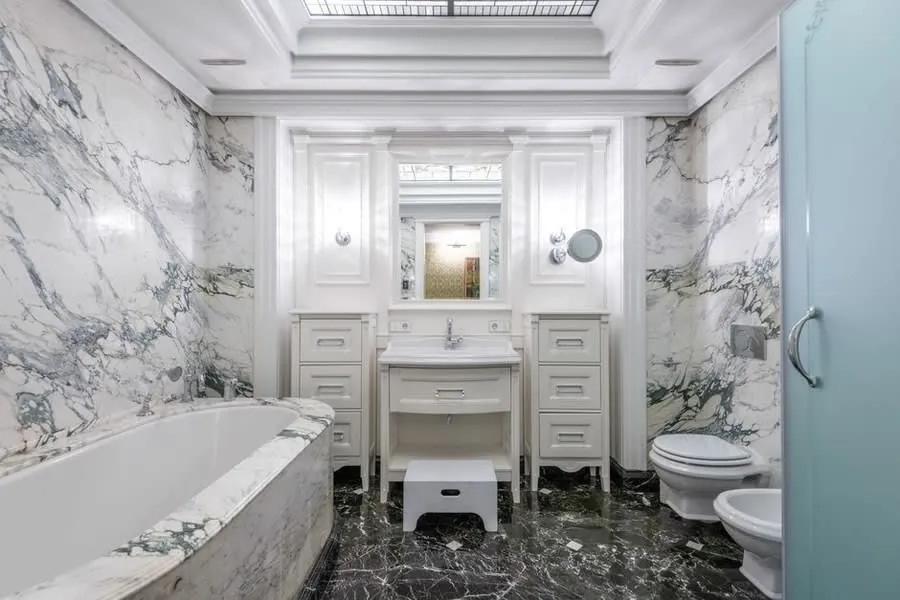
Every number in this article is a guide range for the Exeter and East Devon market in 2026, VAT included, supplied and fitted. The £15,000 and £25,000 examples assume a family bathroom of roughly six to nine square metres. The £40,000 example assumes a principal bathroom of ten to fourteen, because at that budget the room is usually larger and often has been made larger.
Three things move a figure more than any choice of tile. Whether the sanitaryware stays where it is. What the walls and floor turn out to be once the old room is gone. And how much of the specification needs another trade on site, whether that is a stone mason, a cabinetmaker or a structural engineer.
Our Exeter bathroom cost guide sets out the three bands we quote within, and these worked budgets sit inside them: £15,000 near the top of a straightforward replacement, £25,000 in the middle of an altered layout, and £40,000 above our published range, where stone and joinery take over.
£15,000: a conventional bathroom, properly built
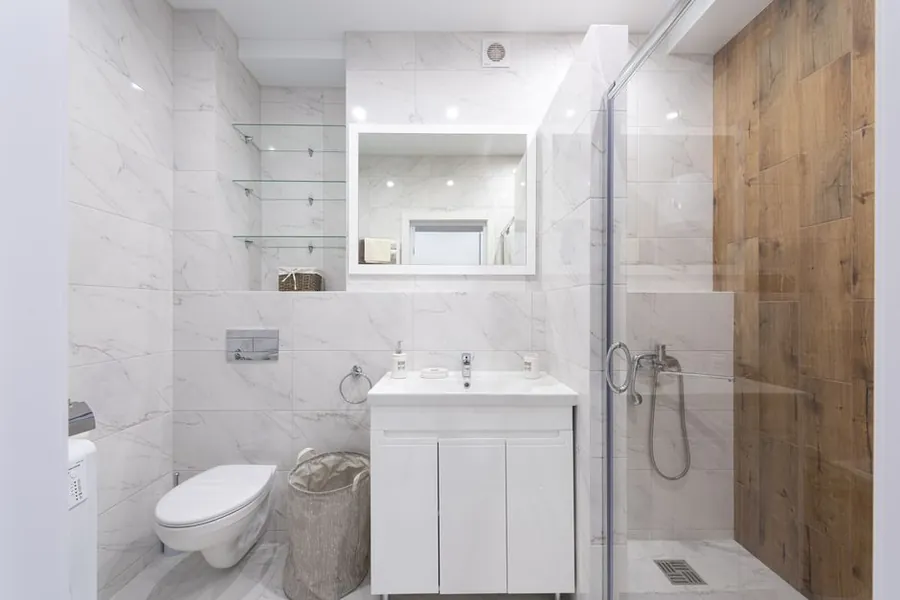
This is the budget for a room that stays where it is and comes out beautifully. Everything is stripped to masonry or stud, the walls are reboarded and the wet zone tanked, and the sanitaryware goes back in broadly the same positions so no waste runs need rethinking.
Roughly £8,500 to £9,500 of it is labour, which is twelve to fifteen working days across plumbing, tiling, electrics, plastering and decorating. The remaining £5,500 to £6,500 buys good British brassware with serviceable cartridges rather than cheap sealed ones, a back-to-wall or wall-hung WC, a vanity with a real carcass, an eight millimetre enclosure or bath screen, and around 25 square metres of porcelain at £30 to £45 a metre.
What it does not buy is anything exotic. No stone, no bespoke joinery, no relocated WC. An electric underfloor heating mat fits at this level and is worth having. A wet system fed off the central heating usually does not, because it needs a manifold, floor build-up and a commissioning visit.
£25,000: the level where design decisions start costing money
Ten thousand pounds more does not buy a bathroom that is twice as nice. It buys hours, and then it buys specification.
The hours go on moving things. A bath comes out and a fully tanked walk-in shower goes in, which means falls formed in the floor, a tanking system applied in coats with curing time between them, and the basin or WC repositioned. That is three to five extra days on site before anyone considers a tap.
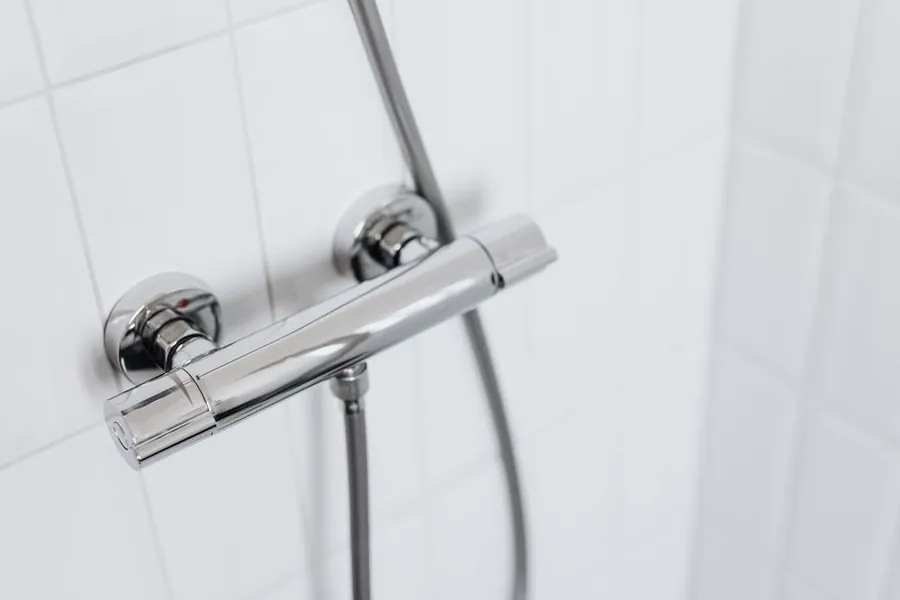
The specification then absorbs the rest. Large-format porcelain at 600 by 1200 or larger, £55 to £90 a metre and slower to set because the substrate has to be properly flat. Underfloor heating with its own programmable thermostat. Brassware from a manufacturer you have heard of, with concealed valve bodies buried in the wall rather than a bar mixer bolted to the tile. Ten millimetre frameless glass, which is the single upgrade clients mention most often afterwards, and which we weighed up in detail in our guide to shower screens and glass. Lighting split across three circuits so the room can be bright at seven in the morning and dim at ten at night.
Labour lands around £14,000 to £15,500 at this budget, materials around £9,500 to £11,000. The ratio barely shifts from the £15,000 job. What shifts is how much of the labour is skilled preparation rather than installation.
£40,000: stone, joinery, and the work behind the wall
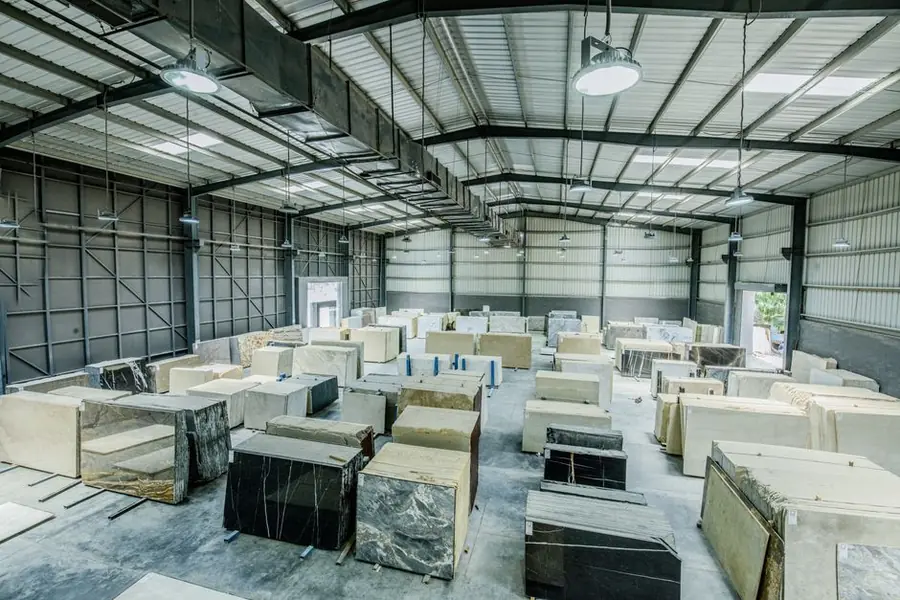
Here the split changes. On a stone-led project materials climb to roughly half the total, somewhere around £19,000 to £21,000 each way, because what is being specified is both expensive to buy and slow to fit.
Natural stone at £150 to £300 a square metre supplied is only the start. Slabs are selected in person, dry-laid on the floor to match veining before anything is fixed, cut with wet saws, and sealed on installation and periodically afterwards. Marble on a wall also weighs enough to need the right substrate and, on a first floor over Victorian joists, sometimes the right structure too. We set out where each material earns its keep in our comparison of marble, porcelain and natural stone.
A vanity from a cabinetmaker rather than a catalogue is £3,500 to £7,000 depending on timber, veneer and whether the top is stone. Concealed cisterns in steel frames behind a boxed wall, with wall-hung sanitaryware hanging off them, cost more in labour than they do in parts. Two shower outlets on separate thermostatic valves need enough flow to run at once, and finding that flow is a plumbing job rather than a bathroom one.
Then there is the part that never appears in the mood board. Somewhere between £3,000 and £8,000 of a £40,000 project disappears into first fix, structural work and making good before a single finish is chosen.
Where the money actually goes
Across all three budgets labour is the largest single slice, typically 55 to 65 per cent, and it only falls below that when the specification is unusually material-heavy. This surprises people who have just spent three weekends choosing tiles.
The more useful way to divide a bathroom budget is into three parts rather than two. There are the things you chose, which is the sanitaryware, brassware, glass, tile and joinery. There is the labour to install them. And then there is the third category nobody selects in a showroom and nobody photographs: first fix pipework and cable runs, tanking, backer board, levelling compound, plastering and making good, skips and waste transfer, protection for carpets and stair runners, certification, and scaffolding if a window or an external stack is involved.
On a £25,000 project that invisible third comfortably accounts for £5,000 to £7,000 once labour and materials are counted together. It is also the part of a quote most worth reading line by line, because it is where a cheap price gets made cheap. If you want the prioritisation argument rather than the arithmetic, our post on where to spend and where to save takes that on directly.
Where projects go over budget
Overruns are rarely mysterious. In our experience they come from the same short list, and the same item tops it every time: moving the soil connection. A WC needs 110 millimetre waste and a consistent fall; a basin does not. Relocating a pan runs £900 to £2,500 depending on whether the route through the joists is obvious, and on a terrace where the stack climbs a visible elevation it may also need permission.
Hot water is next, and it is the commonest surprise at the top of the market. A 250 millimetre overhead head typically wants 12 to 15 litres a minute, and a combi boiler delivering ten will not run that plus a hand shower. An unvented cylinder is £2,200 to £3,800 installed, has to be fitted by someone qualified to work on them, and sits under Approved Document G, the building regulations covering hot water safety.
Then there is whatever the strip-out reveals: decayed joist ends under an old shower tray, blown plaster, lead or steel feeds, asbestos in 1960s floor tiles. Stone brings its own tail of extras too, in sealing, heavier adhesives, longer set-out, and floor stiffening at £800 to £2,000 where the joists were never intended to carry it.
And then there is simply getting into the building, which in this city is a line item rather than an afterthought.
What Exeter and East Devon add to the bill
Water first. South West Water is clear that East Devon is the only area it supplies with hard water, drawn from boreholes rather than the moorland sources feeding the rest of the region. In Honiton, Sidmouth or Budleigh Salterton that argues for easy-clean coated glass, cartridges you can replace rather than sealed ones, and often a softener at £900 to £1,800 installed. In central Exeter the supply is softer and that money can go somewhere more visible. Same specification, different price, twelve miles apart.
Heritage next. The city’s 20 conservation areas include St Leonard’s, Heavitree, Southernhay, Pennsylvania and Topsham, and the council’s conservation area appraisals set out what is expected of work in each one. Bathrooms are internal, so most of a project is unaffected. What is affected is anything that breaks out to the exterior: a new extract terminal, a repositioned soil stack, a replacement window. In a listed building the constraint goes further and the sensible approach is to reuse existing service routes rather than cut new ones, which is slower and therefore dearer.
The last one is the least interesting and the most reliable: getting materials into the house. A bay-fronted terrace in St Leonard’s or Heavitree with residents’ parking on both sides and no off-street space means no skip outside the door, a long carry for every slab and bag, and sometimes a suspended bay arranged in advance. None of it is dramatic. All of it is hours, and hours are the biggest number on the quote.
Common questions
Is £15,000 a realistic budget for a bathroom in Exeter?
Yes, for a room that stays in its existing layout and is finished to a high standard with quality porcelain and good brassware. It is not a realistic budget for natural stone, bespoke joinery or a relocated WC. The honest version of £15,000 is a conventional bathroom built properly rather than an ambitious bathroom built cheaply.
Why does moving the toilet cost so much more than moving the basin?
Because of what the waste has to do. A basin runs on 40 millimetre pipe that can be routed almost anywhere, while a WC needs 110 millimetre waste falling consistently to the stack. Finding that route through joists and floor voids, and reinstating everything afterwards, is typically £900 to £2,500 of work.
How much of a bathroom budget is labour rather than materials?
Usually 55 to 65 per cent, and it only drops towards half on projects specifying substantial natural stone or bespoke joinery. Preparation, first fix, tanking and making good account for a large share of those hours, which is why a quote that itemises them is more useful than one that does not.
Does hard water change what I should spend the money on?
In East Devon, yes. South West Water identifies East Devon as its only hard-water area, so glass with a factory-applied easy-clean coating, brassware with replaceable cartridges and a softener all earn their place there. On Exeter’s softer supply those same items are a preference rather than a necessity.
What should I hold back as a contingency?
Around ten per cent of the contract value on any pre-1940 property, and closer to five on modern housing. What sits behind the tiles is genuinely unknown until the old room is out, and a contingency is what stops an unwelcome discovery becoming a decision you rush.