
Shower Screens And Glass In An Exeter Bathroom
Luxury Bathrooms Exeter
The screen is the largest single object in most bathrooms and it is almost always the last thing anybody thinks about. Tiles get a morning. Brassware gets a spreadsheet. The glass gets ten minutes at the end of a showroom appointment, and then you stand two feet from it every day for the next fifteen years. The arithmetic behind it is more interesting than the attention it gets. Glass weighs roughly 2.5kg per square metre for each millimetre of thickness, so an 8mm walk-in panel 900mm wide and two metres tall is about 36 kilos hanging off one wall. Toughened glass is made to break into blunt granules instead of blades, and the fragmentation test that proves it is written into BS EN 12150. And in the towns east of Exeter, where the supply comes up out of boreholes and not off the moor, that sheet of glass starts collecting calcium the week it goes in. Three decisions, then, not one.
Frameless, minimal-framed and black framed are three different products
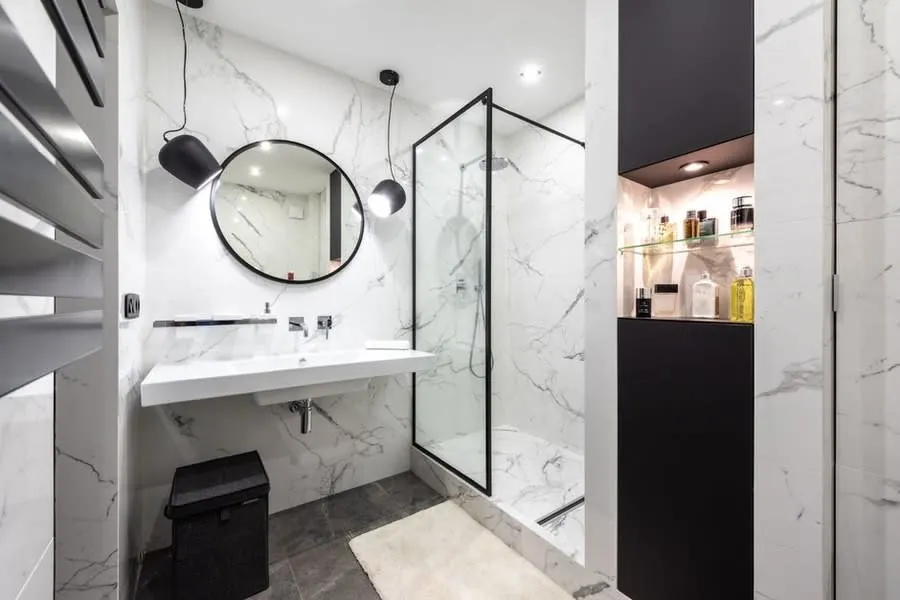
The word frameless is used loosely by almost everyone selling enclosures, and it covers at least two quite different things.
A true frameless screen has no perimeter section at all. The glass is held by discrete brackets or hinges, the edges are polished, and the panel itself is doing the structural work, which is why it has to be 8mm or 10mm. What you get is an uninterrupted sheet with a silicone joint at the wall and nothing else, and in a room where the tiling is the point - book-matched stone, a run of large-format porcelain - that absence is the whole reason to spend the money. It is also the version with the fewest places for anything to grow.
A minimal-framed screen has a slim channel at the wall and often at the floor, usually 6mm or 8mm glass sitting inside it. It costs meaningfully less, it is far more forgiving of a wall that is not plumb, and the channel gives you an adjustment range that a bracket-fixed panel simply does not have. On a Victorian wall in St Leonards or Heavitree, where nothing is straight and nothing is square, that tolerance earns its keep. The trade-off is a channel that holds water and needs cleaning.
Black framed is a third category and is a design decision, not a saving. It is usually the dearer option of the three. We fit all three, and which one ends up on the drawing for a walk-in shower tends to be settled by the wall behind it rather than by taste.
Black framing, and what it does to a small room
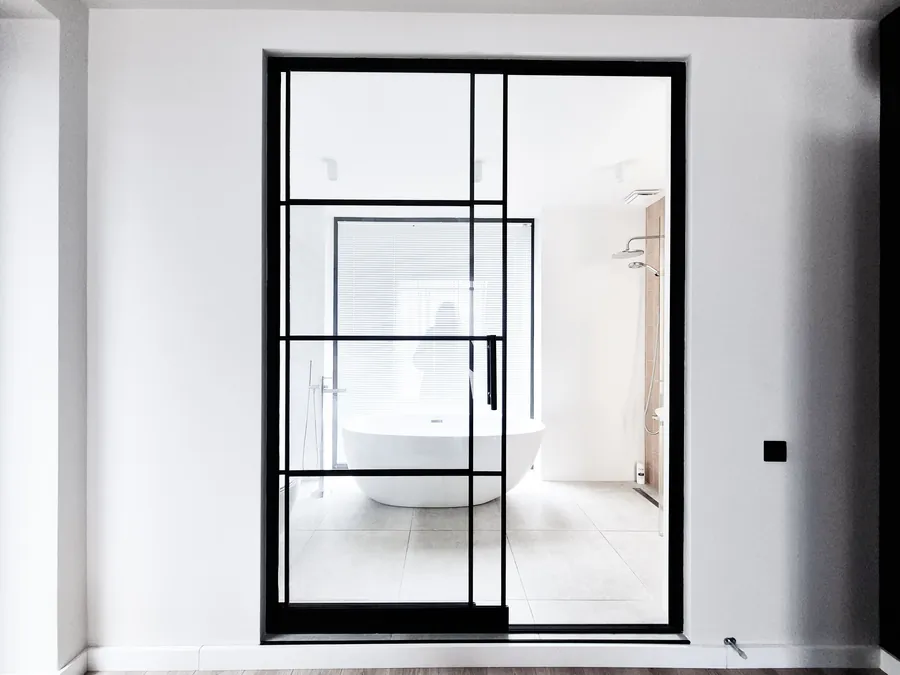
The Crittall-style grid has been the dominant look in bathroom glass for several years now and it earns its popularity in the right room. Against white walls and a freestanding bath it gives an otherwise plain space a structure it would not otherwise have, and in a period house it picks up the metal windows instead of fighting them.
It behaves badly in a small one. A grid is visually solid in a way that clear glass is not, so a 1.7 metre wide bathroom in an Exeter terrace, which is a very common width round here, reads noticeably narrower once you put black bars across the middle of it. The rule of thumb we use is that a full grid wants a room you can stand back in. Below about 2.2 metres of width, a single black perimeter with no internal bars gives you most of the look and takes almost none of the space.
Two practical notes that rarely come up in showrooms. The frame is aluminium with a polyester powder coat, and powder coat chips where things get dropped, which in a bathroom means the bottom 200mm. Ask what the warranty on the coating is, not the one on the glass. And matt black shows dried limescale as a white bloom far more clearly than chrome does, which matters more the further east you are in the county.
Six, eight or ten millimetres
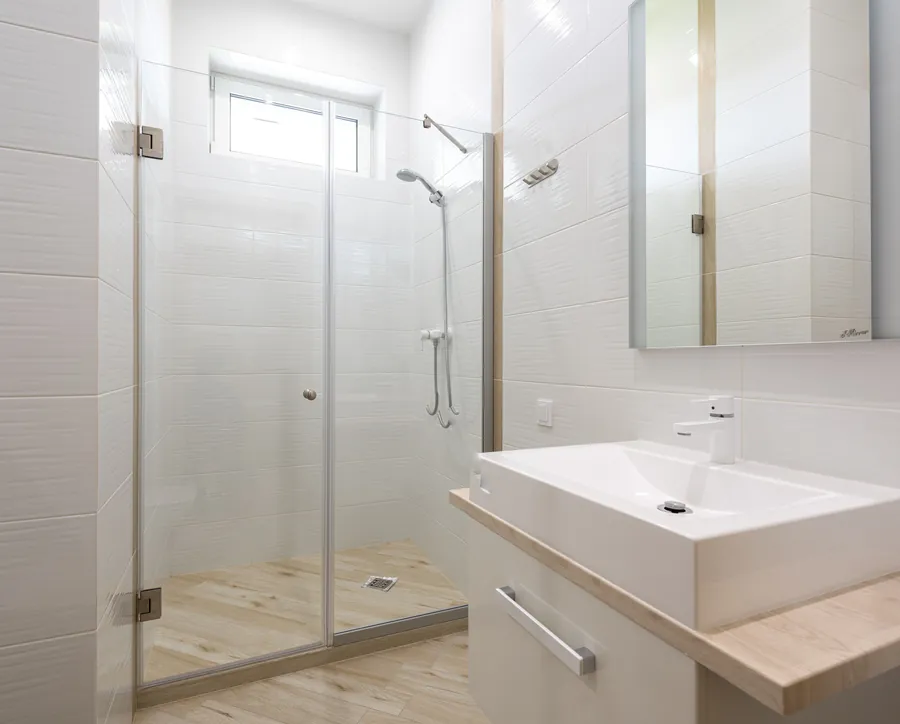
Thickness is where most of the money moves, and the honest answer is that the jump from 6mm to 8mm matters much more than the jump from 8mm to 10mm.
Six millimetre glass is fine on a fixed panel under about 800mm wide, sitting in a channel. It feels light when you touch it and it will flex if you lean on it, but as a bath screen or a narrow return it is perfectly sound. Eight millimetre is the sensible default for almost everything else: it is rigid enough to hang a hinge on, it is what most decent walk-in panels are made from, and it stops the panel moving when the door next to it closes. Ten millimetre buys rigidity and a certain heft in the hand, and it opens up heavier hardware options, but it also brings a real weight problem with it. That 900mm by 2000mm panel goes from about 36 kilos at 8mm to about 45 at 10mm, all of it carried by a handful of fixings in one wall.
Which makes the substrate the question nobody asks. A 45 kilo panel bolted into plasterboard on dabs is a callback waiting to happen, and dot-and-dab is exactly what you find behind the tiles in a 1990s Exminster or Newton Abbot house. Lath and plaster in an older property is worse. The fix is cheap and has to happen before the tiling: solid noggins or a ply pattress screwed between the studs where the brackets will land, mapped from the enclosure drawing. Found afterwards, it is a stripped wall.
Toughened, low-iron, and the mark in the corner
Every panel that goes into a shower should be thermally toughened safety glass, made to BS EN 12150, the British Standard for toughened soda lime silicate glass, which sets out the fragmentation behaviour that makes a broken panel survivable. You will find a small etched stamp in one corner giving the standard and the maker. That stamp is a product conformity mark and nothing more. A lot of trade sites get the next bit wrong, so it is worth being blunt about: the manifestation rules about permanent marking on glass apply to shops and offices and Approved Document K states that they do not apply to dwellings. What Approved Document K does ask of a home is that glazing in a critical location breaks safely, which toughened glass to Class 3 of BS EN 12600 does.
Low-iron glass is the one upgrade here that people misjudge. Ordinary float glass carries iron oxide, which gives it a green cast you see edge-on and across a wide panel. Take the iron out and it goes colourless. On 6mm in a small enclosure the difference is barely there. On a 10mm frameless panel next to pale marble, the green is obvious once somebody points it out, and then you cannot stop seeing it.
Bracing bars, and the panel that cannot do without one
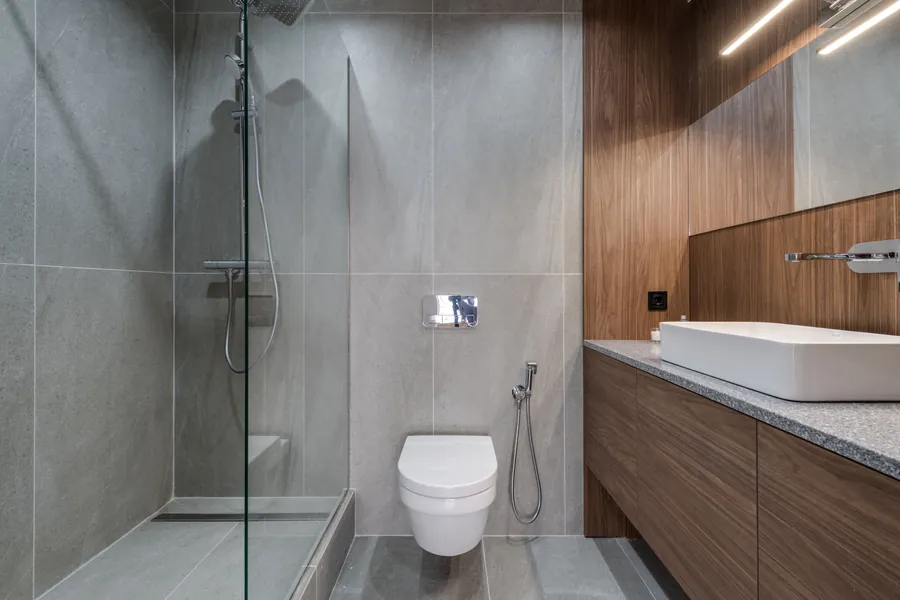
A single free-standing panel deflects. Fixed along one vertical edge and nowhere else, it will move when you push it, and above roughly a metre wide or two metres tall most manufacturers stop warranting it without a support. That support is the bracing bar, and it is the single most common thing to arrive as a surprise on fitting day, because it is drawn as a thin line on a specification sheet and nobody pictures it.
There are three ways to take the load and they look nothing like each other. A wall brace runs at an angle from the top outer corner back to the nearest wall, which is the cheapest and the most visually intrusive. A ceiling brace goes straight up, which reads far quieter and is what we specify where the ceiling will carry it. A glass-to-glass fixing uses a short return panel to stiffen the main one, which removes the bar entirely and costs the most.
Decide it on the drawing. Whatever the bar lands on has to be solid, and that is the whole reason. A ceiling brace into a plasterboard ceiling with no noggin above it is doing nothing, and you cannot add the noggin once the room is finished. The same applies to the wall version. Where a brace lands is a first-fix conversation, weeks before any glass arrives.
Hinged, sliding, or no door at all
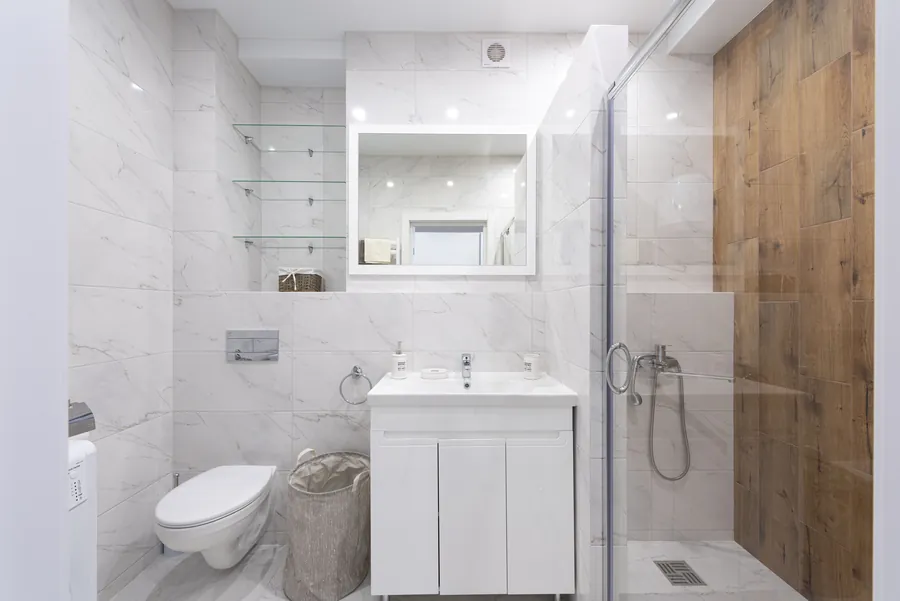
A hinged door needs somewhere to open into, and that is roughly 600mm of clear floor that cannot hold a radiator, a WC or a door swinging the other way. It also carries water out with it: every time it opens, whatever is on the inside face drips onto the floor beyond the tray. In a small room that is the argument against it before anything else.
Sliders solve the clearance problem and introduce a maintenance one. The bottom track is a channel that sits in the wettest part of the room, it collects everything the water is carrying, and in a hard-water area it furs up. Modern top-hung sliders with no bottom track are considerably better and cost more. If a slider is going in, pay for the version without the floor channel.
Which leaves the walk-in panel, and it is what we fit most often. No door, no seals, no track, nothing to adjust and nothing to replace in eight years. What it needs instead is length: enough run between the shower head and the open edge that water has somewhere to fall, which in practice means about 1400mm minimum and comfortably more if the head is a large overhead rainfall. Get that wrong and you have built a machine for wetting the floor. The related question of whether the floor itself should be tanked is a separate one, and we set out the difference in our guide to wet rooms and walk-in showers in Exeter.
What the water east of Exeter does to a sheet of glass
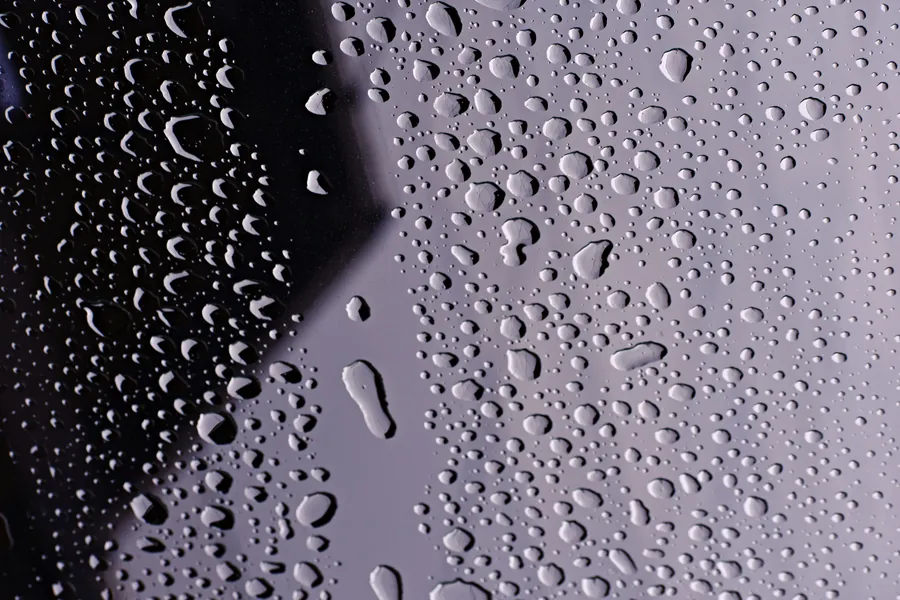
Most of this region drinks moorland water, and moorland water is soft. The exception sits to the east. South West Water draws that part of the county from deep boreholes instead of reservoirs, and its own guidance describes East Devon as the only area it supplies that is considered to have hard water, classed as slightly to moderately hard. For a bathroom in Exmouth, Sidmouth, Budleigh Salterton or Honiton that changes the specification. For one in Exeter or Topsham it mostly does not. South West Water publishes a postcode lookup, and a minute spent checking your own street will settle it better than anything anyone writes about the county as a whole.
What the mineral actually does to glass is not what most people think, and the difference matters. Water sits on the panel, evaporates, and leaves the dissolved calcium behind as a deposit. That part everybody knows. The part that causes permanent damage is what happens next, when somebody attacks the deposit every fortnight with an acidic limescale remover. Glass has a microscopically uneven surface, deposits key into it, and repeated aggressive cleaning slowly etches that surface rougher. A rougher surface holds the next deposit better. Ten years of this is how a panel arrives at the permanent cloudiness that no product shifts, and at that point the only remedy is a new piece of glass. It is the cure that does the damage, not the disease.
Coatings, and whether they actually last
There are two things sold under the heading easy-clean and they are not comparable.
The real one is applied at the factory, before the glass ever leaves the processor, either fired into the surface during manufacture or chemically bonded to it. It fills the microscopic texture so water beads and runs instead of spreading and sitting. These come with long warranties, ten years and upwards, they typically add somewhere between £80 and £200 to a panel, and in an East Devon bathroom they are the best small sum you can spend on the glass.
The other is a bottle of hydrophobic spray you apply yourself. It works. It works for perhaps six to twelve weeks, and then it needs doing again, forever.
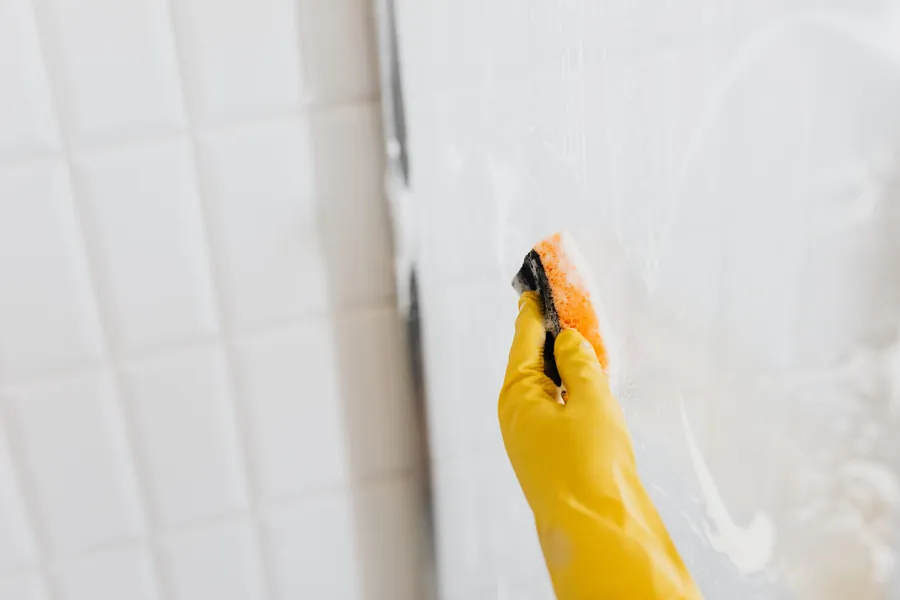
Both are destroyed by the same two things, which is the part the sales literature is quiet about. Abrasive cream cleaners scour the coating off. Strong acidic limescale removers dissolve it. If a screen has a factory coating, the maintenance instruction is a pH-neutral cleaner and nothing else, and a great many coatings are killed within a year by somebody being helpful with a scouring cream.
None of it replaces the one thing that keeps glass clear, which is getting the water off before it can evaporate. A squeegee on a hook, ten seconds a shower, does more than every coating and product combined, because nothing is left on the panel to dry. Where scale has already established itself, Which? recommends citric acid over vinegar as the gentler way to lift it. It is milder than the supermarket descalers, which is exactly why it suits coated glass.
What the glass costs in an Exeter bathroom
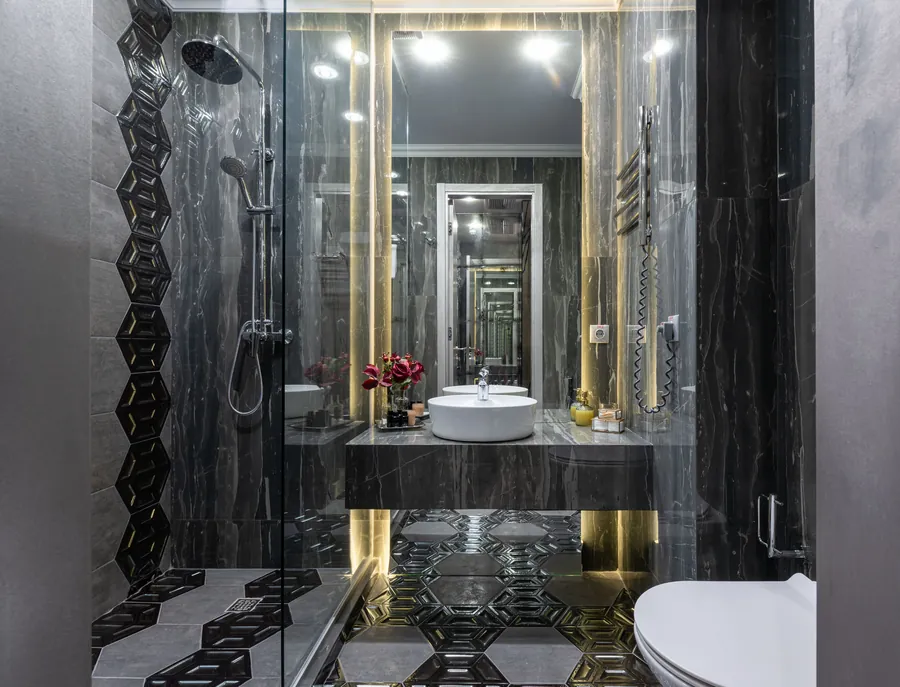
Figures below are supplied and fitted, VAT included, as part of a full installation with us. Glass bought on its own and fitted by somebody else lands lower and comes with nobody to call.
A standard 8mm minimal-framed walk-in panel, 900mm or 1000mm wide, runs roughly £450 to £900 depending on the hardware and the finish. A true frameless panel in 10mm with polished edges and low-iron glass is more like £900 to £1,800. Bespoke made-to-measure frameless work, meaning a hinged door with a return panel scribed to an out-of-square Victorian wall, sits between £1,600 and £3,500 because it is templated on site and made once. A black framed screen is £700 to £1,600 for a single panel, and a full-height Crittall-style partition with a door in it is £2,500 to £5,000 and is closer to joinery in metal than to a shower screen.
The upgrades are the interesting part of the number, because they are small next to the room. Low-iron glass adds around fifteen to twenty per cent to the panel. A factory coating is £80 to £200. A ceiling brace instead of a wall brace is perhaps £60 to £150. Against a bathroom running into five figures, all three are rounding errors. They are also the three you will notice every single morning, which cannot be said for most of what people upgrade.
Common questions
Is 6mm or 8mm glass better for a shower screen?
Eight millimetre for anything that is wide, tall, hinged or free-standing, which is most walk-in panels and every door. Six millimetre is fine for a bath screen or a narrow fixed return sitting in a channel, and paying for 8mm there buys you very little. The bigger jump in feel and rigidity is from 6mm to 8mm rather than from 8mm to 10mm, so if the budget only stretches one step, take that one.
Do black framed shower screens show limescale?
More than chrome does, yes. Matt black powder coat makes dried mineral deposits show as a pale bloom, and it is most visible along the horizontal bars where water sits. That is a cleaning habit, not a fault, and it matters more in Exmouth or Sidmouth than in Exeter. If a Crittall-style screen is going into a hard-water area, plan on a squeegee and a pH-neutral cleaner from day one.
Does a walk-in shower panel need a bracing bar?
Usually, once it is over about a metre wide or two metres tall, and most manufacturers will not warrant a free-standing panel above those sizes without one. The alternative is a glass-to-glass return panel, which stiffens the main sheet and removes the bar altogether, but it costs more and needs the floor space. Whichever it is, decide at design stage, because the bar has to land on solid timber that is fitted long before the glass turns up.
Do easy-clean coatings on shower glass really work?
Factory-applied ones do, and they are worth having in East Devon. They are bonded into the glass during manufacture, carry warranties of ten years or more, and add roughly £80 to £200 per panel. The wipe-on sprays sold separately last a couple of months. Both are removed by abrasive cream cleaners and strong acidic descalers, so a coated panel needs a pH-neutral cleaner or the coating you paid for is gone inside a year.
How much does a frameless shower screen cost in Exeter?
Roughly £900 to £1,800 supplied and fitted for a true frameless 10mm panel with polished edges, and £1,600 to £3,500 for bespoke made-to-measure work with a hinged door and a return. A minimal-framed 8mm walk-in panel, which is what most people actually mean by frameless, is nearer £450 to £900. An out-of-square wall in a period property pushes any of those upward, because the panel has to be templated on site instead of taken off a shelf.