
Marble, Porcelain And Natural Stone In An Exeter Bathroom
Luxury Bathrooms Exeter
A stone sample looks its best on the day you choose it: dry, in a showroom, under lighting picked to flatter it. The more useful question is what it will look like in its fourth winter, in a north-facing Exeter bathroom, after eleven hundred showers and whatever has been sprayed at it since. That is a materials question with a fairly technical answer, and most of the advice you will find stops at “stone is porous, porcelain is easy”. The real picture is more interesting than that. Marble sits somewhere around 3 to 5 on the Mohs hardness scale while porcelain is 7 or above. A porcelain tile takes up less than half a per cent of its own weight in water, where some limestones absorb several per cent. And mains water around Exeter runs near 93 parts per million of dissolved calcium, which is harder than most of Devon and hard enough to change what we would put on your shower floor. That last one gets left out of almost every guide to this subject, and locally it is the one that decides things.
What you are buying when you buy stone
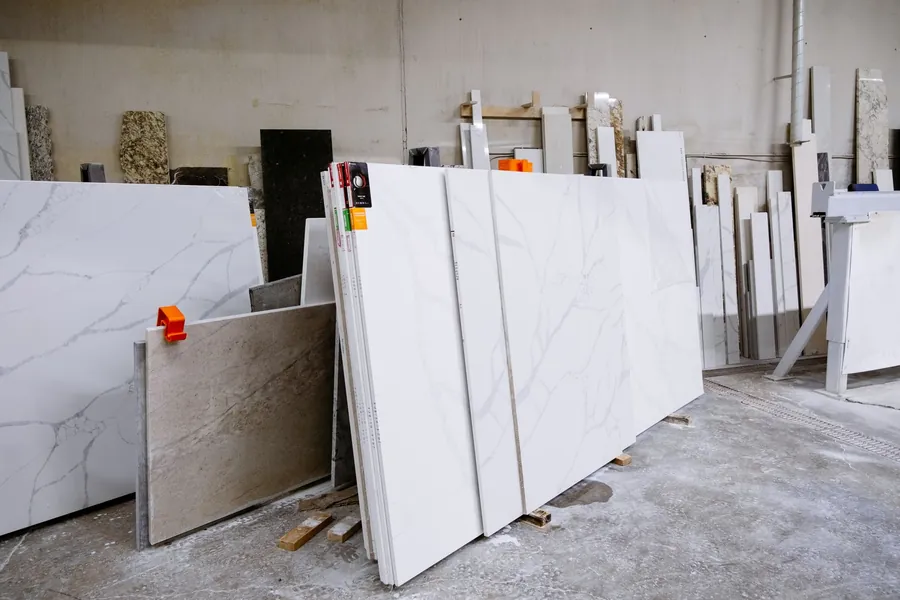
Porcelain is manufactured to a specification. Stone is extracted from a hillside and cut up, and everything that follows from that difference is the thing people are unprepared for.
A crate of marble tiles is sawn from one block, and the next block along in the same quarry can be noticeably greyer, warmer or more heavily veined. This is why a single batch matters more than the name on the label, why ordering ten per cent extra at the outset is not padding, and why a shortfall discovered on the last day of tiling is an expensive problem rather than a phone call. It is also why we lay the whole order out dry before anything is fixed, sorting the busiest pieces away from the calmest ones so the floor reads as deliberate rather than accidental. Stone selection is a real part of a bathroom tiling job and it takes an afternoon, not ten minutes.
The finish is a separate decision from the stone itself, and it is the one people skip. The same marble can be supplied polished, honed, brushed or tumbled, and those four surfaces behave so differently in a wet room that they are effectively four materials. Choosing Carrara and leaving the finish to the supplier is how you end up with a mirror-polished floor you did not intend and cannot comfortably stand on.
Marble: the honed or polished decision comes first
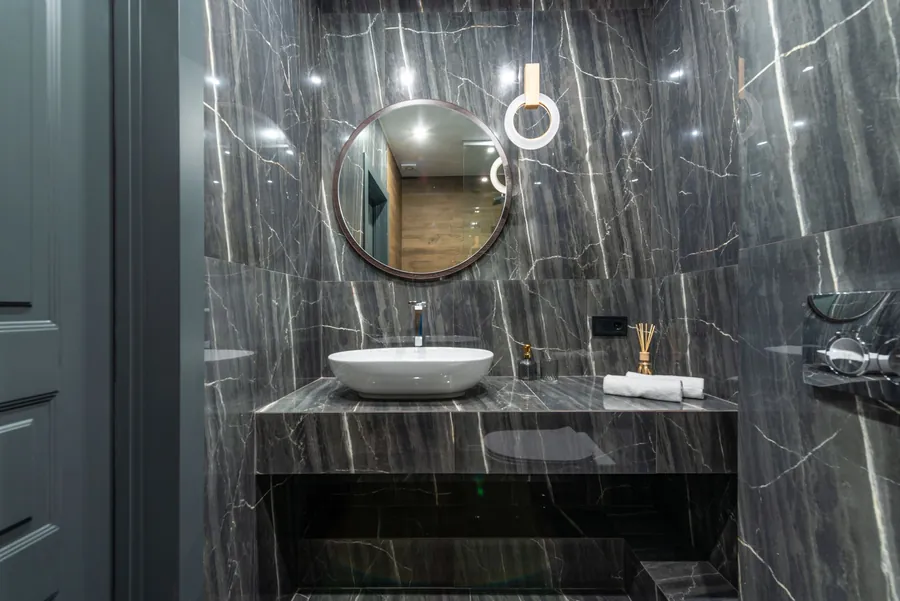
Two things happen to marble in a bathroom and almost everybody confuses them. Staining is absorption: something coloured soaks in and darkens the stone. Etching is chemistry: an acid dissolves a shallow layer of the calcium carbonate the stone is made of, leaving a dull patch where the polish used to be. A sealer prevents the first and does nothing whatsoever about the second, which is why so many owners of sealed marble are baffled by the rings on their vanity top.
The list of things that etch marble is longer and more domestic than you would guess. Limescale remover, obviously. Toilet descaler drifting off the brush. Bleach-based sprays, several shampoos and shower gels, perfume, aftershave, and the half-lemon somebody read about online. None of these needs to sit for long. A minute of contact is enough to leave a mark you can see when the light rakes across it.
So the honed or polished question is not about taste. A polished surface is a mirror, and every etch mark is a hole in that mirror. A honed surface is already matt, so the same chemical damage leaves far less to see and can usually be worked back with a fine abrasive pad. In practice we will specify honed marble on almost any horizontal surface in an Exeter bathroom and reserve the polish for a wall, where nothing pools and nothing gets sprayed.
Grade matters too, though less than people expect. Carrara is the forgiving one, with soft grey veining that hides a multitude of sins. Calacatta and Statuario are whiter and far more dramatic, and they are three or four times the money and considerably less tolerant of being lived on.
Travertine and limestone ask more of you than marble does
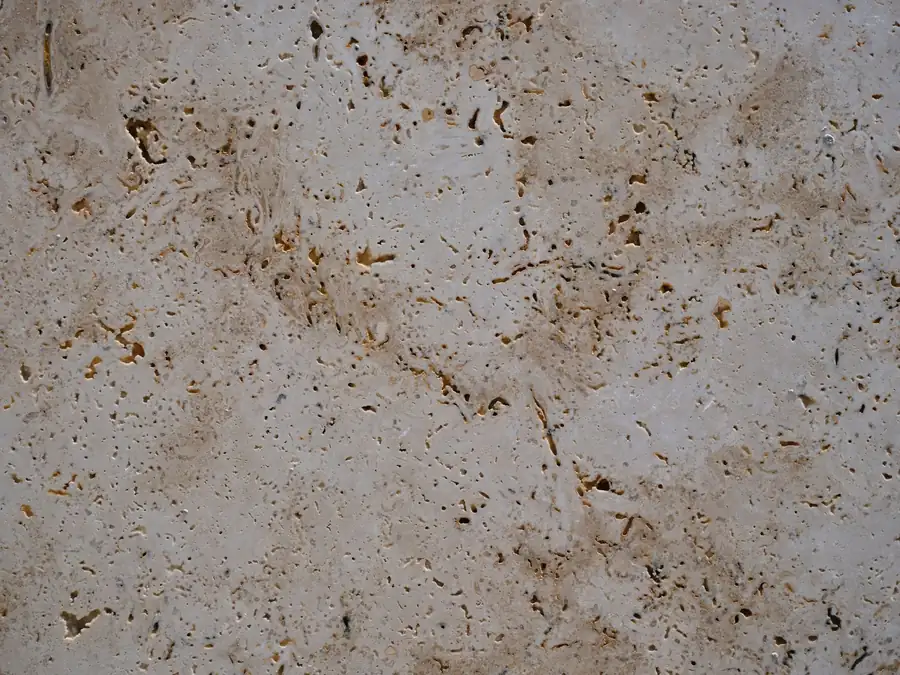
Travertine forms where mineral-rich water comes out of the ground, and gas escaping through it leaves the stone full of small voids. Left open, that pitted surface is the whole charm of the material. Filled with resin or cement and honed flat, it becomes something quite different, and which of the two you have bought is not always obvious from a 100mm sample. The trouble arrives later. Fills are not the same material as the stone around them, they do not wear at the same rate, and in a shower they eventually shrink, craze or drop out, leaving a surface full of small craters at exactly the height where water sits. Every one of them collects scale. Travertine on a wall in a dry corner of a bathroom is a lovely, warm, slightly Mediterranean thing. Travertine on a shower floor is a job we get called back to.
Limestone is softer again and thirstier, and its absorption is the number to ask about rather than assume. It scratches where grit is walked across it, and in a family bathroom it develops visible traffic paths within a couple of years. Both stones want an impregnating sealer applied before grouting, so grout haze cannot stain into the surface, and again once the grout has cured. After that, the honest schedule is roughly annually on a vanity top, every six to twelve months in a shower, and every year or two on a floor. The test is simple enough: drip water onto the stone and watch. If it darkens within a few minutes, the sealer has gone.
What East Devon’s water does to a calcareous floor
Most of the South West is supplied from Dartmoor and Exmoor, and that moorland surface water is soft. Exeter and the towns east of it are the exception, because the supply here comes up out of boreholes through ground that puts calcium into it on the way. South West Water’s factsheet on water hardness classes this area as slightly to moderately hard, and the figure climbs as you move towards Honiton, Sidmouth and the coast.
Now put that together with what marble, limestone and travertine are made of, and you arrive at the trap at the centre of this whole subject. Hard water leaves calcium carbonate deposits on the surface of the stone: a white bloom on a shower floor, a dull film across a honed vanity. Every product sold to remove those deposits works by acid, because acid dissolves calcium carbonate. The stone is also calcium carbonate. The bottle that clears the scale attacks the floor underneath it, and the harder the water, the more often somebody reaches for the bottle.
No clever product escapes this. A pH-neutral stone soap will not harm the surface but will not shift established scale either, so the only real answer is prevention: a squeegee after every shower, and a surface dried rather than left to evaporate. Some households do that cheerfully for a decade. Most do it for a fortnight.
Be honest with yourself about which you are, because that one answer decides the specification. Where a client genuinely wants stone underfoot in the wettest part of the room, softening the incoming supply is one of the few situations in East Devon where a full water softener earns its keep rather than becoming a maintenance task nobody remembers. Otherwise the sensible pattern here is stone where you can see and touch it and water does not linger, and porcelain where it does.
Stone-effect porcelain, and where it genuinely wins
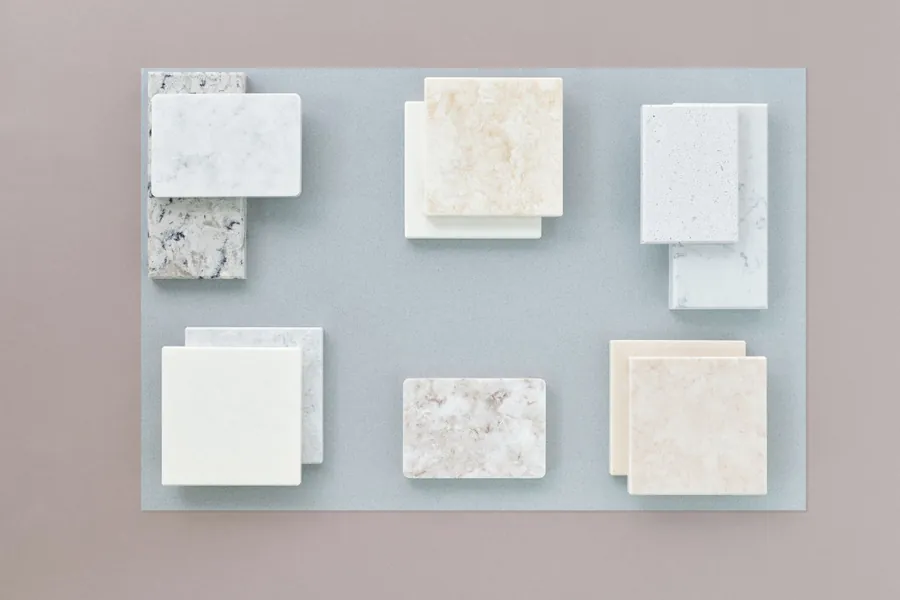
Porcelain is clay pressed hard and fired to around 1,200 degrees until it vitrifies. The result absorbs almost no water, is hard enough to shrug off grit, does not etch when a descaler touches it and never needs sealing. In hard-water East Devon those four properties are worth more than they are almost anywhere else in the region.
Whether it can look like stone is no longer the interesting question, because the good ones now do. Telling a good one from a poor one is, and three checks settle it quickly.
Ask how many different faces are printed in the range. A cheap stone-effect tile has four or six, and on a bathroom floor you will start seeing the same vein in three places; a serious range has twenty, sixty or more, and the repeat disappears. Then look at a cut edge. A glazed tile has the pattern printed on a pale biscuit, so every external corner, every drilled hole and every cut against a shower tray shows a white line unless it is mitred and made good, where full-bodied porcelain carries colour through its thickness and forgives all of it. Last, check whether the tile is rectified, meaning mechanically ground to an exact size, which is what allows a 2mm to 3mm joint instead of a 5mm one. Grout lines are where scale and grime settle, so narrower is not merely neater.
Where porcelain does not quite win is in the hand. A real marble vanity top has a thickness, a cold weight and an edge profile you can run a thumb along, and veining that travels through the slab rather than sitting on its skin. If the stone is the point of the room, a porcelain floor with a marble top is a better division of the budget than a wholly artificial room or a wholly natural one.
Slab or tile, and what that choice actually costs
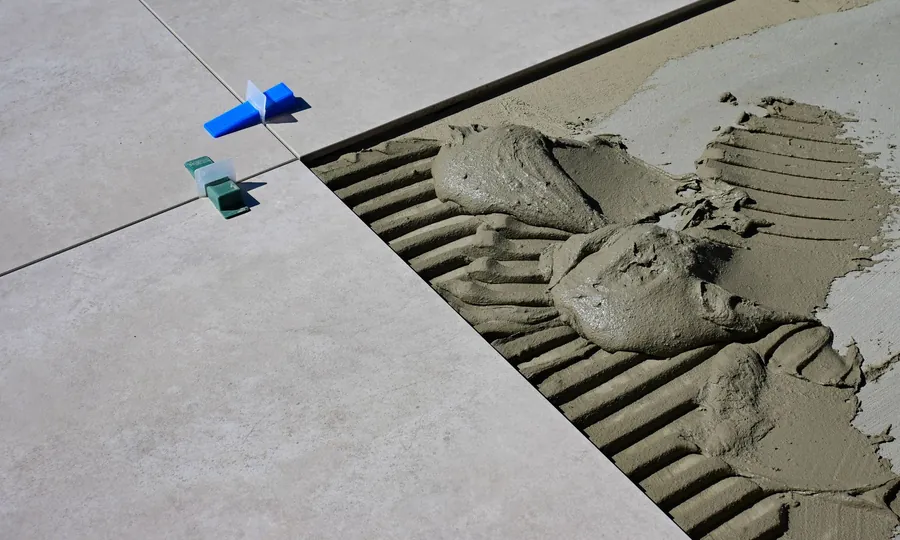
Gauged porcelain now comes in panels up to 1600mm by 3200mm and around 6mm thick, and marble is sold as slabs at 20mm or 30mm. Both can give you a shower wall with no joints in it at all, or a pair of book-matched panels behind a bath that open like a butterfly. It is the most striking thing you can do with either material and it is not a like-for-like swap for tiling.
The costs are logistical before they are financial. A full 3.2 metre panel weighs around 75 kilos, needs a transport frame, a vacuum lifting rig and three or four people, and has to physically reach the room. On a Victorian terrace in St Leonards or a townhouse off Southernhay, the half-landing turn is very often the constraint that decides the answer, and it is better established with a tape measure at survey than discovered on delivery day. Cut-outs for wastes, valves and brackets are machined off site from a survey drawing, so the dimensional accuracy of that survey is absolute: a hole in the wrong place is not a tile, it is the whole panel.
The middle ground is where most of our projects land. A 600mm by 1200mm or 800mm by 1600mm format gives you most of the visual calm of a slab with none of the handling risk. Whichever you choose, the bedding underneath matters more than the size on top. Large formats and natural stone need close to solid adhesive coverage, which means a notched bed plus back-buttering rather than five dabs, and the relevant guidance sits in BS 5385, which The Tile Association has flagged for its recent revisions. A hollow spot under a stone tile cracks under load, and you find it the winter after the job finished, not during it.
Weight, build-up and an Exeter first floor
Run the numbers and the reason first-floor stone needs thinking about becomes obvious. Twenty millimetre marble weighs roughly 54 kilos per square metre. Twelve millimetre is about 32. A 10mm porcelain is around 24, and a 6mm gauged panel about 14. On top of whichever you pick, a backer board and a full adhesive bed add another 10 to 15. So a marble floor in a modest 6 square metre bathroom can put the better part of 400 kilos onto joists that were sized, a hundred and thirty years ago, for a bed and a wardrobe. Add a cast iron bath holding 200 litres and somebody sitting in it, and you have close to half a tonne standing on roughly a square metre of floor.
Stiffness, not strength, is what usually fails first: rigid finishes crack long before a joist is in any danger of breaking. Deflection limits get quoted freely on the internet, and they are a useful sanity check rather than a guarantee, since the Tile Association’s own technical advice notes failures observed even where a floor met a fairly demanding figure. The practical build-up is what we specify from. A period floor gets overboarded and a tile backer board screwed down at roughly 300mm centres with its joints staggered against the boards below, usually with an uncoupling membrane over the top to isolate the stone from seasonal movement in the timber. If the joists themselves need work, notching and drilling limits are set out in Approved Document A of the Building Regulations, and in a listed property the question of what may be done to historic timber comes first, which we covered in our guide to bathrooms in listed buildings in Exeter.
The detail that catches people out is height. Backer board, membrane, underfloor heating and a 20mm stone can take 50 or 60mm off your headroom at floor level, which is a door that no longer swings, a skirting that no longer meets the floor, and on a landing bathroom a top step that has quietly become shallower than the ones below it. All of that is solvable on a drawing and awkward on site, which is the argument for deciding the material before the design is signed off rather than after.
Common questions
Will marble etch in a bathroom, and can it be repaired?
Yes, eventually, and yes. Etching is an acid reaction that removes a shallow layer of the polish rather than a stain sitting on top, so no sealer prevents it. On honed marble the damage is usually barely visible and can be blended out with a fine abrasive pad. On polished marble it shows as a dull patch and needs re-polishing, which a stone restoration specialist can do in situ. Choosing honed in the first place is the cheaper version of this conversation.
How often does natural stone in a bathroom need resealing?
Roughly once a year on a vanity top, every six to twelve months in a shower enclosure, and every one to two years on a floor, though the schedule depends on the stone and how hard the room is used. Rather than working to the calendar, drip water on the surface. If it soaks in and darkens the stone within a few minutes, it is due. If it beads and sits there, leave it alone.
Can you tell stone-effect porcelain from real marble?
Close up and in good light, usually yes, mostly from the cut edges and the way the pattern repeats. At normal viewing distance on a floor, a good full-bodied porcelain with twenty or more printed faces is very hard to call. The tell is almost never the face of the tile now. It is a white line at a mitred corner or the same distinctive vein appearing twice in one room.
Does a stone floor need the joists strengthening in a Victorian Exeter house?
Sometimes, and it depends on span, joist size, spacing and what previous work has done to them. A 20mm marble floor plus bedding is around 65 kilos per square metre before anything stands on it, so it is worth a proper look rather than an assumption. Often the answer is overboarding and an uncoupling membrane rather than structural work, but that should follow an inspection with the boards up, not a guess from the doorway.
Is honed or polished marble better for an Exeter bathroom?
Honed, for almost every surface that gets wet or touched. It hides etch marks, it is less slippery underfoot, and it does not show water spotting from hard water the way a polish does. Polished marble is worth having on a feature wall or a splashback where nothing pools, and it looks superb there. Using it on a shower floor is a decision most people regret by the second winter.