
Heated Towel Rails And Designer Radiators For An Exeter Bathroom
Luxury Bathrooms Exeter
A towel rail tends to be the last line on a bathroom specification and the first thing you touch after a bath, which says something about how badly it is usually chosen. Picked from a brochure for its looks, it often turns out to be the only heat in the room, sized for towels rather than people. Heated towel rails in Exeter have more to cope with than most. A great deal of the city’s housing is solid-walled - Victorian brick in St Leonard’s and Heavitree, older stone and cob further out - and a nine-inch brick wall loses heat several times faster than the insulated wall of a Cranbrook new build. Bathrooms are also designed warmer than other rooms, at around 22C rather than the 21C of a living room. Then there is the water: soft in the city, genuinely hard a few miles east in Exmouth and Sidmouth. We take those in the order that matters, which is heat before looks.
A towel rail is a heater first and a towel rail second
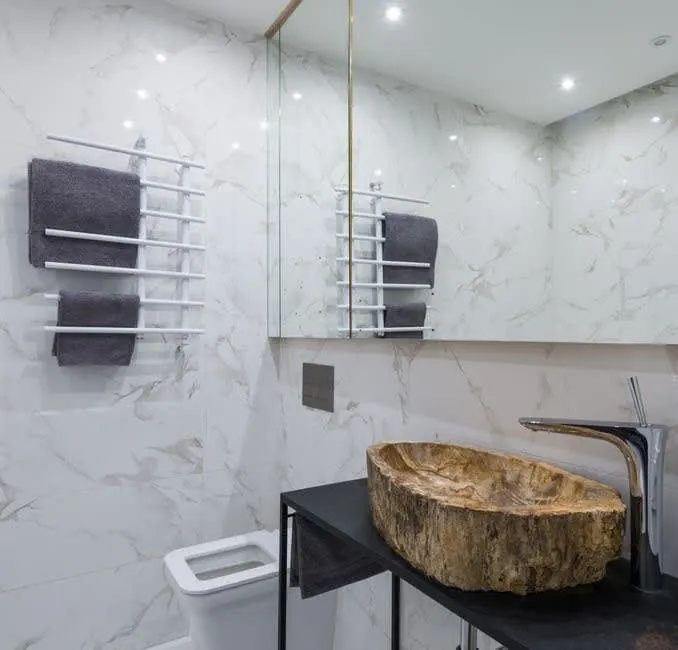
In most of the bathrooms we design, the rail replaces the radiator rather than joining it. That is a sensible trade in a small room, but it changes the job description. A rail that is hung with two damp bath sheets is a rail giving most of its heat to the towels, and a room that relies on it alone will feel cool exactly when you are standing in it wet. So the first question isn’t which style. It is how much heat the room needs and whether one rail can provide it.
Where the answer is no, there are three honest options. Fit a bigger rail, or two. Pair the rail with a designer radiator on another wall. Or let a heated floor carry the background warmth while the rail looks after the towels, which we have written about separately in our piece on whether underfloor heating is worth it in a bathroom. Which one suits your room is something we settle at survey, as part of a full luxury bathroom installation, because it decides where pipes and cables run long before the tiler arrives.
Sizing heated towel rails: watts, BTU and the small print
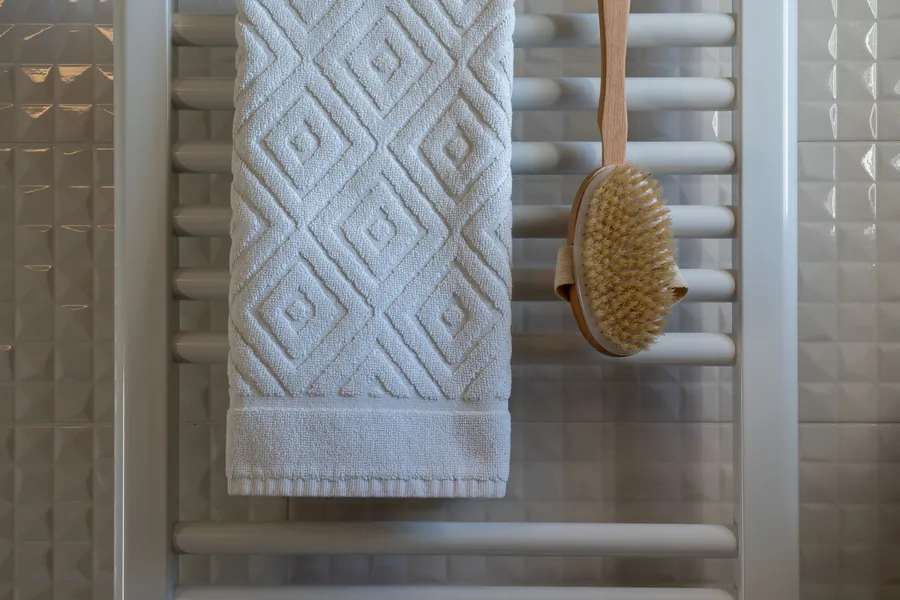
Rails are rated in watts, BTU per hour or both, and the conversion is simple: one watt is 3.412 BTU an hour, so a 500W rail is roughly 1,700 BTU. The figure itself is the easy part. What matters is the condition under which it was measured. Almost every published output is quoted at Delta T50, the European test standard, which assumes the water inside averages 70C in a room at 20C. Very few modern systems run that hot.
A condensing boiler set up to actually condense runs cooler, and a heat pump runs much cooler again. At Delta T30 a rail gives out only about half its headline figure. At Delta T25, typical of a heat pump on a cold morning, it is nearer two fifths. That is why a rail that looked generous on paper can feel lukewarm in practice, and why we size from the system’s real flow temperature, not the brochure.
Finish moves the number too. Chrome is a poor radiator of heat, and manufacturers’ tables commonly show a chrome rail giving out around a quarter less than the identical model painted white. Straight bars give out slightly more than curved ones, and closely spaced bars more than open ladders.
The room sets the target. For a bathroom we work out heat loss through each wall, window, floor and ceiling at a 22C design temperature, rather than leaning on a watts-per-cubic-metre rule of thumb. Two rooms a mile apart show why. A back-addition bathroom in a Mount Pleasant terrace, with three exposed solid walls and a single-glazed sash, can need far more heat than a larger en suite in a recent Newcourt or Cranbrook home. Undersize the rail and the prettiest finish in the catalogue will not make that room pleasant at seven on a January morning.
Heated towel rail finishes that sit with brass, black and chrome
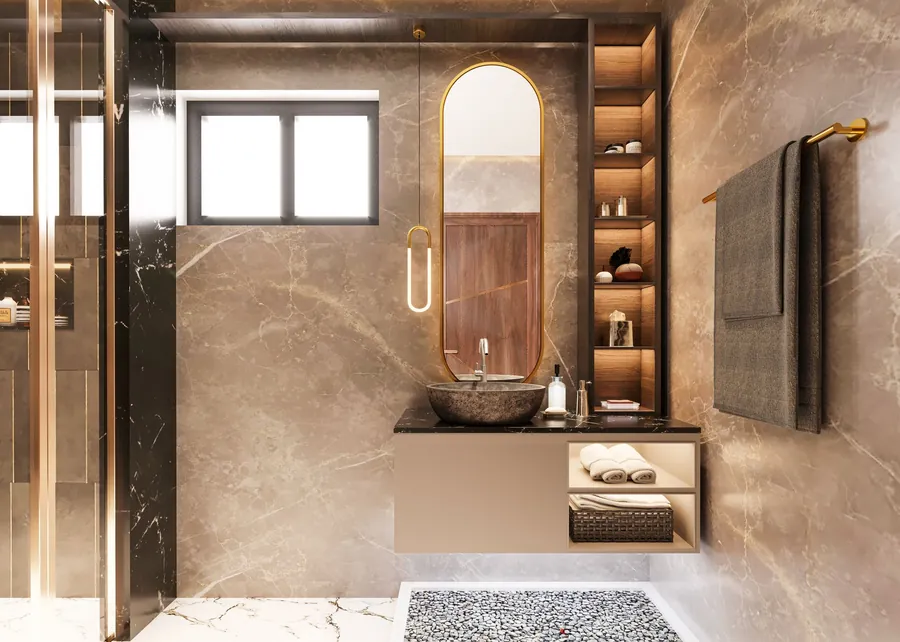
Once the brassware is chosen, the towel rail becomes the largest piece of metal in the room, and a mismatch shows. We covered how tap finishes wear in our guide to brushed brass, matt black and chrome; the rail raises a different issue, which is that it is heated. Finishes behave differently at 60C than they do on a cold tap.
Chrome earns its place as the default. It is hard, cheap to produce on steel, and every brassware range has a chrome version, so the match is exact. Its weaknesses are the output penalty above and a surface that shows every drip.
Matt black and anthracite are usually powder coated. A good powder coat handles heat well and actually radiates better than chrome, so a black rail of a given size tends to outperform a chrome one. The colour match is the catch. Brassware blacks vary from a soft charcoal to a near-graphite, and a powder-coated rail is rarely the same black as the tap beside it. We ask for physical samples of both and look at them together in the room’s own light before ordering.
Brass, bronze and gold tones are where the specification needs the most care. At the better end they are PVD coatings, the same vapour-deposited finish used on premium taps, and some makers will coat a rail in exactly the shade of their brassware. Cheaper “brass-effect” rails are often lacquered or painted, and lacquer on a heated surface can yellow or craze over a few winters. If the rail is a different maker from the taps, we would rather choose a deliberately contrasting finish, warm white against brushed brass for instance, than chase a near-miss.
Central heating, electric or dual fuel
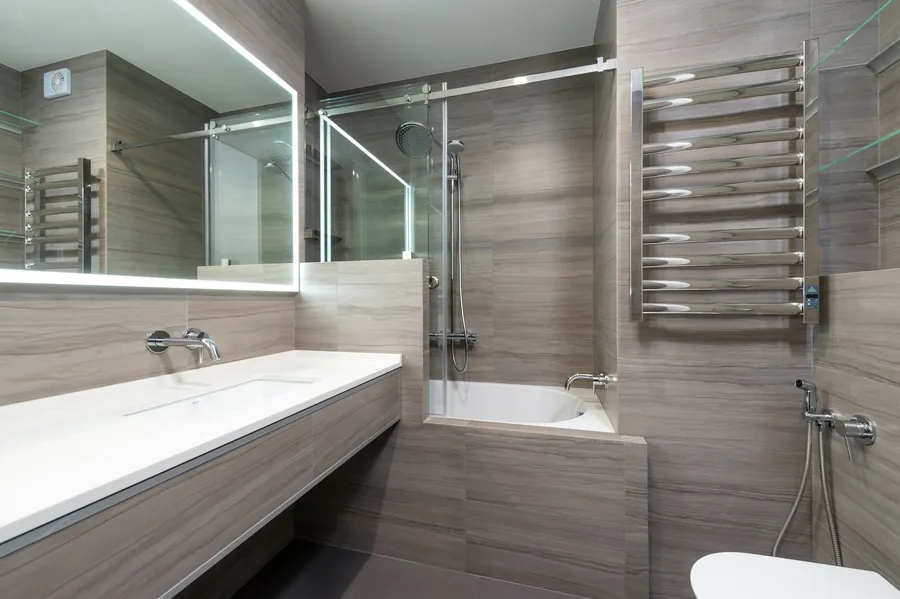
A rail on the central heating is the cheapest to run and the simplest to fit, since it is just another radiator on the circuit. Its limitation is obvious once summer arrives: when the heating is off, so is the rail, and in a Devon June the towels still need drying.
An electric rail runs from the mains alone. Most are sealed at the factory and filled with a water and glycol mix, warmed by an element at the base, with a thermostat and timer either on the element or on the wall. They suit en suites at the far end of a house, rooms where running new heating pipe would mean lifting a period floor, and anyone who wants the rail on at times the boiler is not. Electrical work in a bathroom has to follow the zone rules, so the connection unit usually sits outside the wet zones and the rail is wired, not plugged in.
Dual fuel combines the two. The rail is connected to the heating in the normal way and also carries an electric element in one leg, joined by a T-piece below the bars. In winter it runs on the boiler; in summer you shut the flow valve and switch on the element. There is one rule we repeat at every handover: never close both valves while the element is on. Water expands as it heats, and with nowhere to go the pressure inside the rail can climb until something fails. Leave the return valve open and the expansion goes harmlessly back into the system.
If a heat pump is in your plans, perhaps with the £7,500 available through the government’s Boiler Upgrade Scheme grant for heat pumps, size every rail and radiator for the lower flow temperature now, even if the boiler stays for a few more years. In our experience the bathroom is the room most often under-sized after a switch, and dual fuel is a sensible hedge because the element gives you hot towels whatever the heat pump is doing.
Designer radiators and period rooms
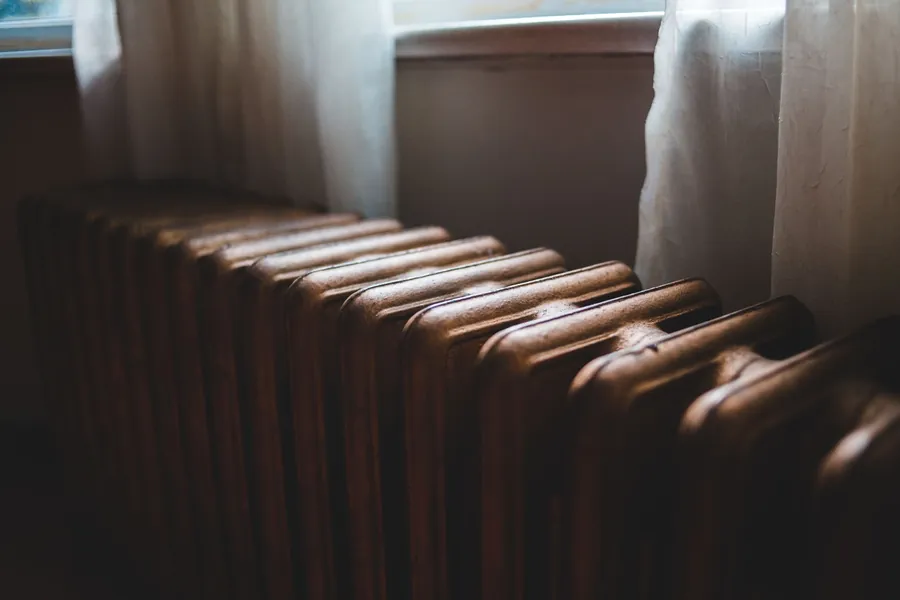
Sometimes the right answer is a radiator with a rail attached, or a proper radiator alongside one. Cast iron column radiators belong in Georgian and Victorian rooms in Southernhay, St David’s and Topsham, and they hold heat long after the boiler stops. They are heavy, though. A large one full of water usually needs floor-standing feet, and on old suspended timber floors we check what the joists are doing before committing to one. Steel column radiators give the same look at a fraction of the weight, and many take a slim rail across the top.
Tall vertical radiators earn their place in narrow terrace bathrooms, where the only free wall is a tall strip beside the door. Aluminium designs suit heat pumps and rooms that are used in short bursts, because they hold little water and warm up quickly.
If the house is listed, the radiators themselves can be part of what is protected. Original cast iron, and the pipe runs that serve it, may need listed building consent to remove, from Exeter City Council in the city and Topsham or East Devon District Council for places like Sidmouth and Budleigh Salterton. Our guide to bathrooms in listed buildings covers how consent works. Being in a conservation area alone does not control what happens inside.
Hard water, soft water and what each does to a rail
Inside a sealed heating system, hardness matters less than people fear. The same water circulates for years, so once its small dose of calcium has dropped out, there is little more to come. Scale becomes a problem when fresh water keeps being added: a slow leak, a system that keeps losing pressure, or repeated draining down to fit new rails. Each top-up brings another load of minerals in Exmouth, Sidmouth, Budleigh Salterton or Honiton, and it ends up in the boiler’s heat exchanger rather than the rail.
Exeter’s soft water creates the opposite risk. The Drinking Water Inspectorate’s explanation of water hardness notes that softer water is more corrosive to pipes, which in a heating circuit means steel rails and radiators rusting from the inside and sludge collecting in the bottom bars. Either way the fix is the same: whenever rails are added, the system should be cleaned, flushed and dosed with inhibitor in line with BS 7593, ideally with a magnetic filter on the return. Factory-sealed electric rails sidestep the issue entirely.
Outside the rail, East Devon water leaves its mark wherever a wet towel drips. On polished chrome and smooth matt black those drips dry to chalky rings. Brushed and satin finishes hide them far better, and a quick wipe with a damp microfibre cloth beats any descaler, which can dull PVD and powder coat alike.
Running costs, worked through
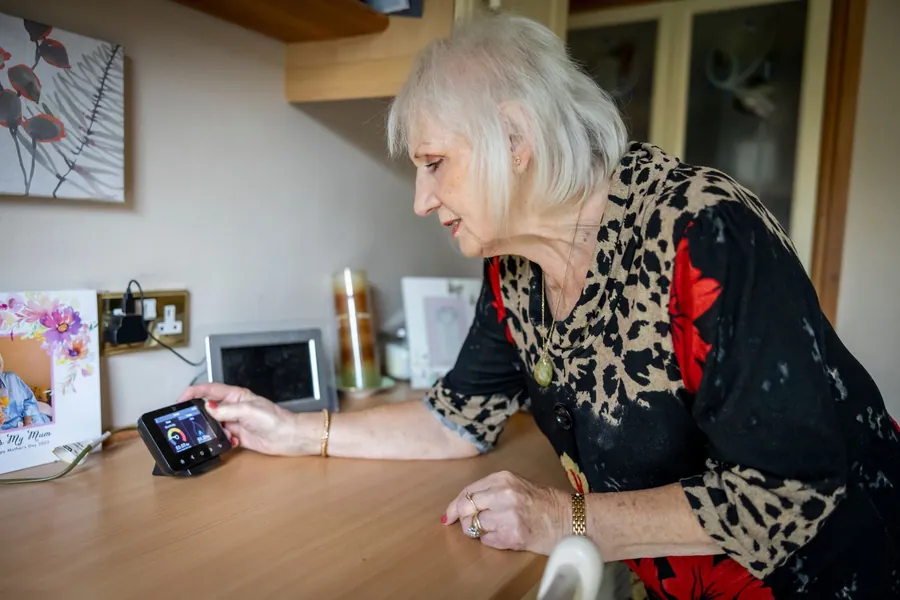
Under the Ofgem price cap for October to December 2026, the average unit rate is 26.32p per kWh for electricity and 7.97p for gas, for a direct debit customer. Electricity is VAT-free under the cap for that period. Those are averages, and your region and tariff will differ, but they are good enough for a comparison.
Take a 300W electric element running for two hours a day. If it ran flat out, that is 0.6kWh, or just under 16p a day, which is around £58 over a year. In practice a thermostatic element cycles off once the rail is up to temperature, so the real figure is usually lower. The same heat from a gas boiler at around 90 per cent efficiency costs roughly 9p per kWh of heat, against 26p for electricity, so the boiler is about three times cheaper for every unit of warmth.
That is the case for dual fuel in a sentence: the boiler for the long winter hours, the element for the summer weeks when firing up the whole heating system just to dry towels would cost more. Whatever you choose, put it on a timer. Two short sessions, morning and evening, use far less than an element left on all day.
Common questions
What size heated towel rail do I need for my bathroom?
Enough to meet the room’s heat loss at a 22C design temperature, measured at your system’s real flow temperature rather than the Delta T50 figure in the brochure. Solid-walled period bathrooms in Exeter often need much more output than modern rooms of the same size, and a chrome rail gives out roughly a quarter less than the same model in white.
Is a dual fuel towel rail worth it?
Usually, if the rail is the only heat in the room or you want warm towels in summer. It runs on the central heating in winter and an electric element when the heating is off. Never close both valves while the element is on, because the water inside needs room to expand.
Do heated towel rails suffer from limescale in East Devon?
Inside a sealed heating system scale is limited unless fresh water keeps being added through leaks or repeated draining. The visible issue in Exmouth, Sidmouth and Honiton is white rings where wet towels drip, which brushed and satin finishes disguise better than polished chrome or smooth black.
How much does an electric towel rail cost to run?
A 300W element running for two hours a day uses at most 0.6kWh, just under 16p a day at the October to December 2026 price cap rate of 26.32p per kWh. A thermostatic element cycles off once warm, so the real cost is usually lower.
Will a matt black or brass towel rail match my taps?
Only if it is checked against a physical sample. Black powder coats and brass PVD shades vary between manufacturers, so we compare the rail and the brassware side by side before ordering, or choose a deliberate contrast rather than a near-miss.