
Microcement And Seamless Bathroom Finishes In Exeter
Luxury Bathrooms Exeter
The photo usually arrives on someone’s phone: a hotel bathroom in Lisbon or a Cornish holiday let, grey or chalky-white walls running into the shower with not a single grout line anywhere. Microcement and other seamless bathroom finishes have gone from niche to something people in Exeter now ask about at most design visits. The look is real and it can last, but it’s a different animal from tiling. The whole finish is about 2 to 3mm thick, so every crack, bump and joint in the wall behind it can eventually show through. The same thinness is why it can wrap a niche, a bench and a vanity top in one continuous skin. This post covers what these finishes actually are, how they’re built up over boards and tanking, where they hold and where they let you down, how Exeter’s older houses and its water change the picture, and how to tell a good applicator from someone who did a two-day course last spring.
Microcement, tadelakt and the other jointless finishes
“Seamless” gets used for several products that behave quite differently, so it helps to separate them early.
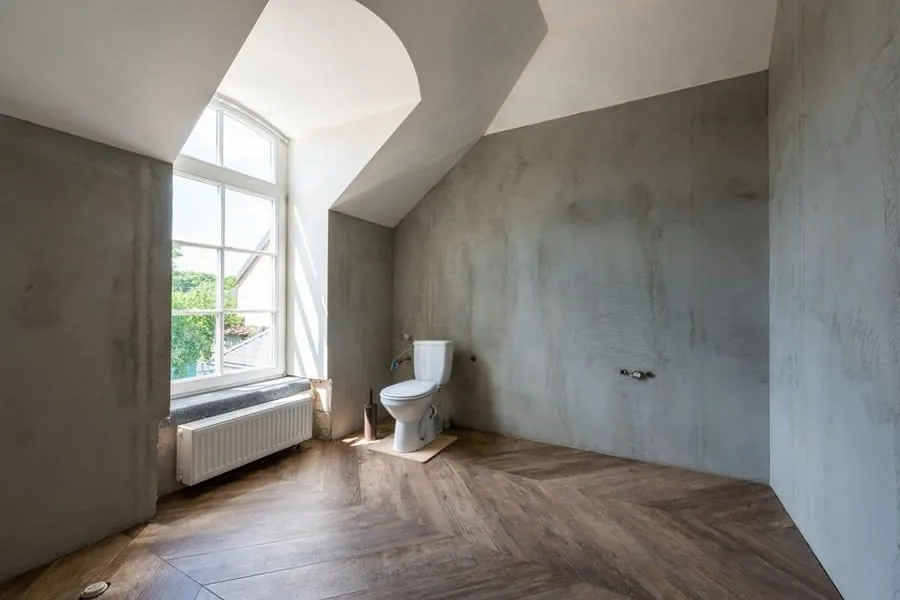
Microcement
Microcement is a mix of cement, polymer resins, fine aggregate and pigment. It’s trowelled on in thin coats and then sealed. The polymers give it some flexibility and grip, and the sealer is what stands up to water and cleaning. It goes on walls, floors, shower enclosures, bath surrounds and vanity tops, and the texture runs from a soft, mottled stone look to something close to polished concrete.
Tadelakt
Tadelakt is a lime plaster from Morocco, where it has lined hammams for centuries. It’s compressed and polished with a smooth stone while still damp, then rubbed with black olive-oil soap. The soap reacts with the lime to form a water-repellent surface. It’s softer to the eye than microcement, with a slight sheen and gentle undulations, and it’s slow, specialist work. Expect to wait for the right person.
Polished plaster
Marmorino, Venetian plaster and other polished plasters and Venetian plaster look wonderful on a dry wall behind a bath or basin. They aren’t built for a shower, and anyone offering them inside an enclosure should explain exactly how they’ll seal it.
Which one suits you is part of the bathroom design conversation as much as a technical choice. The finish sets the mood of the whole room, so it’s worth deciding before the layout and fittings are final.
How a seamless finish goes on over boards and tanking
The thing nobody sees decides whether it lasts. When a seamless finish fails, the cause is usually underneath it rather than in the coating.
A typical microcement wall in a shower is built in layers, roughly in this order:
- A rigid, stable background. Usually cement-based or foam tile backer boards screwed or bonded at close centres, with every joint taped.
- The waterproofing. Most microcement brands sell their own tanking membrane or waterproof primer as part of the system, and in a wet zone it goes on full height, exactly as it would under tiles.
- A primer, then a base coat with a fibreglass mesh bedded into it. The mesh spreads stress across board joints and corners so they don’t crack the surface later.
- Two thin finishing coats, sanded or burnished between applications.
- Two or three coats of sealer, normally a water-based polyurethane, with a matt, satin or gloss sheen.
Each coat needs time to dry, and most systems ask you to keep a shower out of use for several days after the final seal, sometimes longer. Building it this way takes a week or so for a shower room on top of the strip-out and plumbing. That’s slower than tiling the same space with large porcelain.
We’ve written separately about tanking and waterproofing a luxury bathroom, and everything there applies here. A sealed microcement surface sheds water well, but the membrane underneath is what actually keeps your wall dry. If a quote mentions the finish and not the membrane, ask about it.
Where seamless finishes work, and where they fail
Microcement does best on surfaces that don’t move: walls built from boards or sound masonry, concrete floors, and solid built-in features such as a shower bench, a bath panel or a vanity plinth. It earns its keep on curves and returns, where tiles would need dozens of cut edges. A tiled niche has four cut corners per tile row. A microcemented one has none.

Vanity tops are possible and look striking, but they take more abuse than walls. Toothpaste, hair dye, nail varnish remover and wet razors all sit on them, and a matt sealer marks more readily than a gloss one. If you want a seamless top, choose a tougher sealer and accept that it may need a fresh coat sooner than the walls.
Most failures follow the same few patterns:
- Floors that flex. A first-floor bathroom on timber joists moves every time someone walks across it. Without a stiff deck over the joists, the floor cracks along the board lines within a year or two.
- Mixed backgrounds. Where new board meets old plaster, or a stud wall meets a solid one, the two move differently. Those joints need mesh, and sometimes a deliberate movement joint, or a hairline will appear right along them.
- Shower floors without grip. A smooth sealed floor is slippery when wet and soapy. Wet areas need an anti-slip additive in the sealer or a textured finish.
- Underfloor heating switched on too soon. Turning heating up hard before the finish has cured can crack it. Most systems give a gradual warm-up schedule.
Exeter’s older houses: solid walls, movement and lime
A lot of Exeter’s housing was built before cavity walls were normal. The Victorian and Edwardian terraces around Heavitree, St Thomas, Mount Pleasant and Polsloe mostly have solid brick walls. Some older houses and boundary walls use the city’s red Heavitree stone, and cob turns up in villages just outside the city. These walls were built to take in a little moisture and let it out again through lime mortar and lime plaster.

That matters because a fully sealed microcement skin lets very little vapour through. Put it straight onto an old solid external wall and you risk trapping damp behind it, where it can stain, blow the finish off in patches or move into the room next door. The Society for the Protection of Ancient Buildings’ advice pages set out why traditional walls need to stay breathable, and the same thinking applies to a bathroom in a Victorian semi as much as to a listed farmhouse.
The usual answer is to stop the seamless finish touching the old wall at all. A shower area is built out on battens or a framed stud wall lined with backer board, with a ventilated gap behind it, and the microcement goes onto the board. Tadelakt, being lime, is more forgiving of a breathing wall than microcement is, but it still needs a stable, solid background and a careful plan in any wet zone. Ask any applicator what they’ll put on an old solid wall before they touch it.
Living with it: water, limescale, sealing and condensation
How much limescale you’ll fight depends on where you live. South West Water’s water hardness factsheet says most of its supply comes from moorland rivers and reservoirs and is soft or moderately soft. East Devon is the exception: it’s fed from deep boreholes, and that water is classed as slightly or moderately hard. In most of Exeter you’ll see very little scale. In Exmouth, Sidmouth, Budleigh Salterton or Honiton, a dark microcement shower wall will show white water marks unless it’s squeegeed after use.
The bigger risk is how people clean it. Acidic limescale removers, bleach sprays and scouring pads eat into polyurethane sealers, and on tadelakt, acid attacks the lime itself. Lemon juice and vinegar do the same, however natural they sound. Day to day, a pH-neutral cleaner and a soft cloth are enough. Ask for the brand’s own cleaning product, and keep the leftover sealer.
Sealers wear, especially on floors and around the shower head. Expect to clean and re-coat the busiest areas every few years, and sooner on a family shower floor than on a guest en suite. Tadelakt is looked after with an occasional rub of black soap or wax.
Condensation is no worse on microcement than on tile, since both are sealed surfaces that don’t soak up steam. Cold external walls in older Exeter houses do mist up quickly in winter, though, and water running down a matt wall can leave marks. A properly sized extractor, run long enough to clear the room, does more for a seamless finish than any cleaning product.
Microcement versus large-format porcelain on cost
If what you want is “few joints”, large-format porcelain is the obvious competitor. A slab of 1200 x 2400mm or larger can line a shower wall with one or two joints, and it’s harder wearing than any sealed coating.

Square metre for square metre, good microcement supplied and applied often lands in the same broad bracket as large-format porcelain fitted by a skilled tiler, and sometimes above it. The materials aren’t the expensive part. The labour is: several visits, drying time between coats, and a skilled hand on every surface. Small rooms full of corners, niches and boxing-in are where microcement gets closer to porcelain on price, because those details cost a tiler time too. Large plain walls favour porcelain.
Remember the background as well. Both finishes need a flat, rigid, tanked background, so that cost doesn’t go away whichever you choose. Repairs differ too. A chipped porcelain slab may be impossible to match, while a damaged patch of microcement can often be filled and blended, though a perfect invisible repair is never guaranteed. If you’re weighing up cheaper options for the dry walls, our comparison of bathroom wall panels and tiles covers that end of the market.
How to vet a microcement or tadelakt applicator
Specialist applicators are much thinner on the ground than tilers, so it’s tempting to book whoever has a gap in the diary. A shower is a big thing to redo, though, and a few questions will sort the trained from the hopeful.

Before you book anyone, ask:
- Which system do you use, and are you trained on it? Most serious microcement brands train and list their applicators. Mixing one brand’s base coat with another’s sealer can void any product guarantee.
- Can I see a shower you finished at least two years ago? New work always looks good. Wear shows at the shower head, the floor and the edges.
- What goes behind it? Listen for backer board, meshed joints and a named tanking membrane. “It’s waterproof on its own” is the wrong answer.
- Will you make me a sample board? A sample in your own colour and sheen, seen in your bathroom’s light, avoids most disappointments.
- Which sealer, how many coats, and when will it need doing again? You should leave with a written care sheet.
- Who’s responsible if it cracks? If one firm does the boards and tanking and another does the finish, agree in writing who answers for what.
TrustMark, the government-endorsed quality scheme for trades, is a reasonable place to check a business has been vetted. It won’t tell you how good someone is with a trowel, though. The two-year-old shower will.
Common questions
Is microcement a good idea in a shower?
Yes, if it goes onto a rigid, fully tanked background with mesh at the joints and a proper sealer on top. Built that way it holds up well. Problems come when it’s treated as the waterproofing or applied over a wall or floor that moves.
Can microcement go over existing tiles?
Sometimes, on walls, if the tiles are firmly bonded and the grout lines are filled first. On a full renovation we’d rather strip back so we can check and tank what’s behind. Old tiles hide whatever water has already done.
Is tadelakt better than microcement for an old Exeter house?
Tadelakt is lime-based and more compatible with traditional walls, but it’s softer, slower to apply and more easily marked by acidic cleaners. For most older houses the safer option is to build the shower out on a framed, boarded wall and finish that, whichever material you pick.
How do I clean a microcement bathroom?
Use a pH-neutral cleaner and a soft cloth, and squeegee shower walls if your water is hard. Avoid limescale removers, bleach, vinegar and anything abrasive, and re-coat the sealer on the busiest areas every few years.