
Bathroom Wall Panels Or Tiles? An Honest Answer For Exeter Homes
Luxury Bathrooms Exeter
Somewhere in the region of a third of the bathrooms we survey in Exeter now have at least one panelled wall, and the question arrives at nearly every design appointment: are wall panels actually any good, or should everything be tiled? The honest answer annoys both camps. A decent solid-core panel system will keep water out of a shower for fifteen years or more, goes up in a day rather than a week, and can cost half as much per square metre once labour is counted. Porcelain and stone will outlive the panel two or three times over, carry detail no printed sheet can fake, and hold their value in a way that matters when a £20,000 bathroom meets an estate agent. Treating it as a product war misses how the decision works on site. A bathroom has a wet zone, splash zones, dry walls and a ceiling, and the sensible answer is different for each. This is how we take the decision, wall by wall, in the houses this city is actually made of.
The right question is which wall, not which product
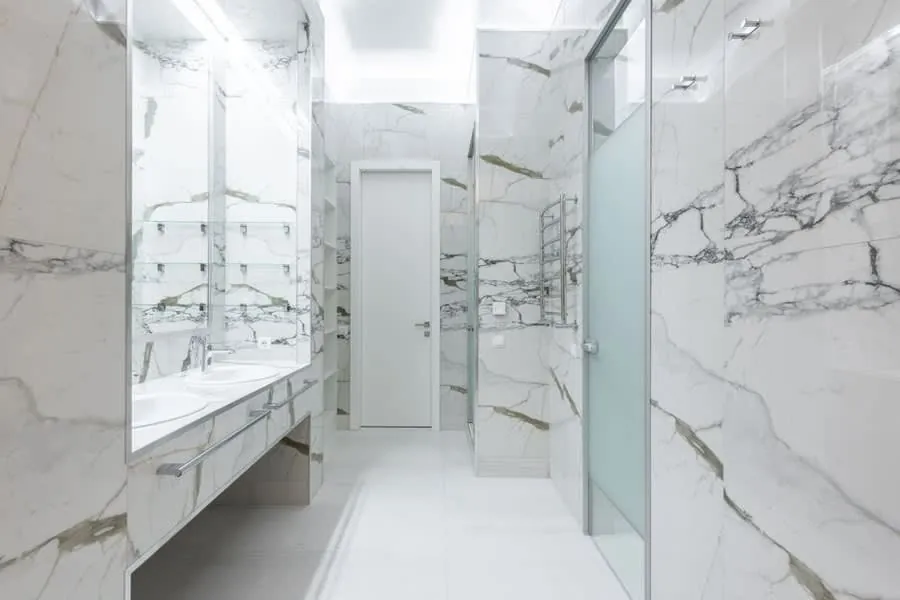
Walk into any bathroom and the walls are doing four different jobs. The shower enclosure gets hit with hot water twice a day and has to be genuinely waterproof, not just wipeable. The wall behind the basin catches splashes and toothpaste. The wall behind the door mostly holds a towel rail and some steam. The ceiling gets nothing but condensation. Cladding all four in the same material is a styling choice, not a technical requirement, and some of the best rooms we build deliberately mix: full-height tile in the wet zone, painted or panelled elsewhere.
That framing dissolves most of the argument. Panels versus tiles is rarely all-or-nothing; it is a budget-allocation question about where each material’s strengths are actually needed. Our bathroom tiling service in Exeter exists because wet-zone tiling done properly is a trade in its own right - and precisely because it is labour-intensive, it pays to be deliberate about which walls get it.
One number worth holding onto: in the mixed rooms we fit, the wet zone is typically only 25 to 40 per cent of the total wall area. Whatever you choose for it, most of the room’s walls are a separate, cheaper decision.
What wall panels actually are in 2026

“Wall panels” covers three products that have little in common beyond the name, and lumping them together is how people end up disappointed.
At the bottom sit hollow-core PVC cladding planks, the £15-per-square-metre product sold for ceilings and quick rental refreshes. They are light, cheap and fine overhead, but they dent, their joints are visible every 250mm, and in a shower they are the material equivalent of a temporary fix.
The product people usually mean is solid laminate panelling: a 10 or 11mm plywood or compact-grade core with a decorative laminate face, sold in sheets up to 1.2m wide with proprietary jointing. This is a serious material. The better systems carry manufacturer warranties of 15 to 30 years in wet use, the printed faces now mimic stone and concrete convincingly from a metre away, and a metre-wide sheet puts one joint in a shower where tiling would put two hundred grout lines.
At the top, large-format porcelain slabs - 1.2m by 2.4m sheets of real porcelain, 6mm thick - blur the categories entirely: the seamless look of panelling in the material of tile, at a price above both. They appear in our work where clients want bookmatched stone veining running unbroken through a shower, and they need specialist handling that neither a tiler nor a panel fitter necessarily has.
So when someone asks whether panels are any good, the first response is: which of these three? The answer differs by a factor of ten in both price and lifespan.
Where panels genuinely earn their place

There are situations where we recommend solid laminate panels without hesitation, even to clients who arrived wanting tile everywhere.
Speed is the obvious one. A shower enclosure panels out in a day, sealed and usable within 24 hours. The same enclosure in tile is three to four days of work plus curing before it can be tanked, tiled, grouted and sealed. In a one-bathroom household - which is most of Exeter’s terraced stock - every day the only shower is out of action has a real cost, and panels can shorten a full renovation by close to a week.
Joints are the second. Grout is the maintenance liability of a tiled bathroom: it needs sealing, it stains, and in hard water it wears visibly. A panelled shower has two or three sealed joints in total. For clients who want a bathroom they can wipe and forget - landlords, second homes, and anyone who has fought mouldy grout for a decade - that is not laziness, it is a rational specification.
Ceilings are the third, and the one nobody thinks of. A steam-heavy shower room with a painted ceiling grows mould along the cold corners no matter how good the extraction is; a clad ceiling wipes clean and never flakes. We panel ceilings in rooms where every wall is tiled.
And panels are forgiving of imperfect walls, which matters more in this city than the brochures realise - more on that below.
Where tile is still the only answer

Everything a panel does, it does in flat, metre-wide planes. The moment a design asks for more than planes, tile stops being an option among options and becomes the only one.
Detail is the clearest case. A recessed niche with a lit shelf, a herringbone floor turning up into a shower kerb, a border course at dado height, mosaic wrapping a curved wall - all of this is assembled from small pieces, and panels cannot be assembled from small pieces. The same is true of edges: tile finishes into trims, mitres and returns that read as built-in; panels finish into extrusions that read, however discreetly, as applied.
Longevity is the quieter case. Porcelain fixed to a sound substrate is effectively a permanent finish - the failure point is the grout, which is renewable, not the tile. A laminate panel’s face is its lifespan; once fashion moves or a corner gets chipped by a ladder, the whole sheet comes off. Across the 25-year life we design bathrooms around, a tiled wet zone is fitted once, while a panelled one is plausibly fitted twice.
And there is the value question. At the finish level we work at, buyers and valuers in Exeter read full-height tiling or stone as evidence of quality, and read panelling - fairly or not - as evidence of economy. In a £400,000 St Leonard’s terrace with a £25,000 bathroom, cladding the shower in printed laminate undermines the rest of the spend. Panels belong in the supporting cast of a luxury room, not the lead.
The wall behind matters more than the surface on it

Whichever surface wins, the wall underneath it decides whether the choice succeeds, and this is where a surprising amount of bathroom failure starts.
Tile has hard limits here. The industry standard that governs tiling, BS 5385, caps the weight a background can carry: roughly 20kg per square metre on gypsum plaster and about 32kg on plasterboard fixed direct - and large-format porcelain with its adhesive can push past the plaster figure on its own. That is why our wet zones are stripped back and re-boarded with cement backer board and tanked before a single tile goes up, and it is one reason a proper tiling quote contains preparation days that a cheaper one does not. Trade guidance from The Tile Association, the UK body for the wall and floor tiling industry, is blunt that most tiling failures are substrate failures, and our experience agrees.
Panels are more tolerant - an 11mm solid sheet bridges hollows that would crack grout lines - but tolerance is not immunity. A panel screwed and bonded over crumbling plaster is only as secure as the crumbling plaster, and the sealed joints still depend on rigid, dry framing behind them. The one unforgivable shortcut with either material is the one advertised most loudly: fixing over existing tiles or failing plaster to save the strip-out. It buries the previous bathroom’s problems where they can rot quietly, and it costs perhaps £300 of saved labour against a four-figure repair when the wall finally lets go.
What each route costs in an Exeter bathroom

Ranges rather than promises, because both routes swing with the product chosen - but these are the brackets our recent Exeter projects have landed in, per square metre, supplied and fitted with proper preparation.
Solid laminate panelling typically comes out at £90 to £150 per square metre - the sheets themselves are £40 to £80, and fitting is quick. Mid-range porcelain tiling lands at £130 to £200 per square metre once backer board, tanking, adhesive, grout and a good tiler’s time are counted, and natural stone or intricate formats push £200 to £300, because small-format and pattern work is slow. Large-format porcelain slabs sit at £250 and beyond with their specialist installation. Hollow PVC cladding is far below all of this, £30 to £50 fitted, and priced accordingly in every sense.
Two things follow. First, the real gap between good panels and mid-range tile is smaller than the marketing suggests - often £40 to £60 per square metre - because preparation and labour dominate both. On a typical 12-square-metre wet zone that is a saving of £500 to £700, not thousands. Second, the gap widens sharply as tile ambition rises, which is why the wall-by-wall approach works: spend the tiling budget where hands and eyes actually land, and let cheaper surfaces carry the walls nobody touches. Our guide to choosing bathroom tiles for an Exeter home covers the tile side of that decision in detail.
What Exeter’s houses do to the decision

The city’s housing stock leans on this choice harder than most places. Exeter’s Victorian and Edwardian terraces - Heavitree, St Thomas, Mount Pleasant - carry lime plaster on lath that is over a century old, and those walls are never flat. Out of level by 20mm over a wall height is unremarkable. Tiling such a wall properly means dubbing out or re-boarding first, which adds a day or two of preparation; panelling it means the battening absorbs the irregularity more cheaply. In a tight-budget period terrace refit, that is a legitimate reason panels win the dry walls.
But the same houses argue for tile in the wet zone. Solid brick walls run cold, condensation pressure in an old one-bathroom terrace is relentless, and a tanked, tiled, properly ventilated shower is the most robust assembly we can put against a cold external wall. Ventilation is not optional either way - the extract rates in Approved Document F of the building regulations apply whether the walls are panelled, tiled or papered, and no wall covering fixes a bathroom that cannot exhale.
Newer stock flips the logic. In the plasterboard-and-timber bathrooms of Alphington’s and Pinhoe’s recent estates, the walls are flat and dry, preparation is minimal, and the panels-versus-tiles gap becomes purely one of look, feel and lifespan - and at the standard we fit, tile usually wins all three.
So: panels for speed, ceilings, dry walls and honest budgets; tile for wet zones, detail, longevity and value; and never either one over a wall that should have been stripped. The rooms that get this right rarely have to choose at all.
Common questions
Are bathroom wall panels as good as tiles?
Good solid laminate panels are excellent at the specific things they do - fast installation, minimal joints, easy cleaning - and a properly fitted system will keep a shower watertight for 15 years or more. They cannot match tile for detail, edge quality, lifespan or resale impression. Treat them as a different tool rather than a cheaper imitation, and use each where its strengths apply.
Can you put wall panels over existing tiles?
Manufacturers permit it on sound, dry, well-fixed tiles, but we advise against it. Panelling over old tiles seals in whatever condition the wall behind is really in, adds thickness that upsets fittings and edges, and saves only a few hundred pounds of strip-out. If the old tiles are failing, covering them hides the problem exactly where you cannot see it develop.
Which is cheaper, panels or tiling?
Fitted like for like, solid laminate panelling in Exeter typically runs £90 to £150 per square metre against £130 to £200 for mid-range porcelain tiling, so the saving on a normal wet zone is usually £500 to £700 rather than thousands. Cheap PVC cladding is far cheaper again but is not a serious shower material. The gap widens if you want stone, patterns or large formats in tile.
Do wall panels work in an old house with uneven walls?
Yes - better than tile, in one sense, because the battening behind panels absorbs unevenness that tiling would need re-boarding to correct. But the fixings still need sound material to bite into, so failing lime plaster has to come off first regardless. In Exeter’s older terraces we often panel the uneven dry walls and fully re-board and tile the wet zone.