
Bathroom Mirrors And Mirror Cabinets In Exeter: Lit, Plain Or Recessed
Luxury Bathrooms Exeter
Of everything in a finished bathroom, the mirror is the piece you look into rather than at, which is probably why it gets chosen last and in a hurry. It shouldn’t be. The mirror decides how your face is lit at seven in the morning, whether the glass clears after a shower, how much storage sits above the basin and, if it is a cabinet, how much of the wall has to be cut away to hold it. For bathroom mirrors in Exeter there is a fourth question that showrooms rarely raise: what the wall behind is made of. A recessed cabinet that slides neatly into the stud partition of a modern new build can be a poor idea in a Victorian party wall in St Leonard’s, and a genuinely bad one in a cob cottage out towards Broadclyst. What follows is the order we work through it with clients - the type of mirror, its size, its light, its glass, the electrics and finally the wall.
Plain glass, lit glass or a cabinet
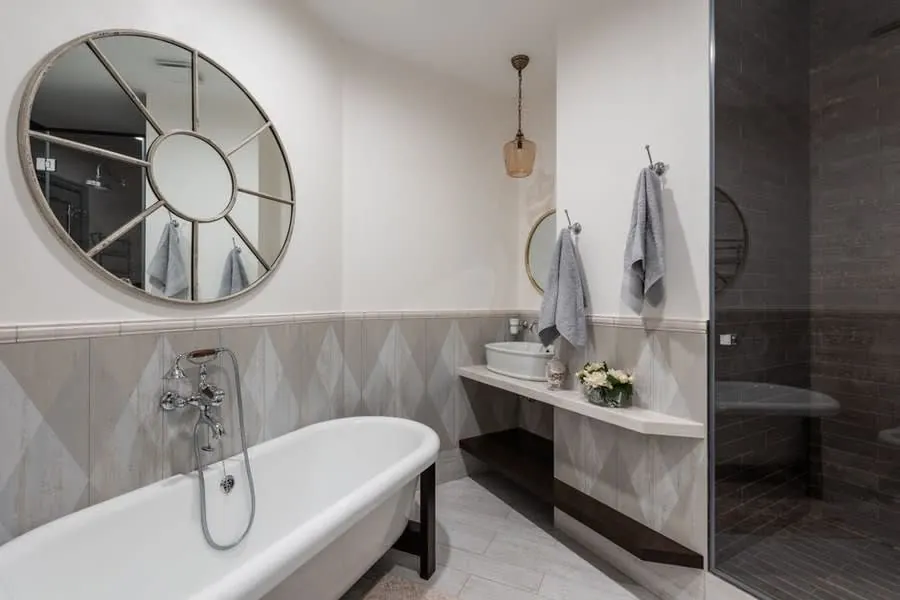
Bathroom mirrors come in three broad kinds, and they suit different rooms. A plain mirror, framed or frameless, is the most enduring choice. It has nothing in it to fail, and it leaves the lighting to fittings chosen on their own merits. In a period house it is often the right answer purely on looks: a bevelled or antiqued glass in a slim metal frame belongs in a Georgian or Victorian room in a way that a glowing rectangle never quite does.
An illuminated mirror carries its own light, usually LEDs behind a frosted band or around the edge, and often a demister and a touch switch. It makes most sense in narrow rooms where there is no width either side of the basin for wall lights, and in modern schemes where the glow is part of the look. The trade-off is lifespan. The glass will last decades; the driver and LED strip inside it will not, and when they go the whole unit usually goes with them.
A mirror cabinet adds storage behind the glass and, at the better end, lighting, a demister and a shaver socket inside. As part of a full bathroom design we settle which of the three it will be before the walls are boarded, because each needs something different behind the plaster: a fixing zone, a cable in a set position, or a void deep enough for a cabinet box.
Sizing a mirror to the vanity below it
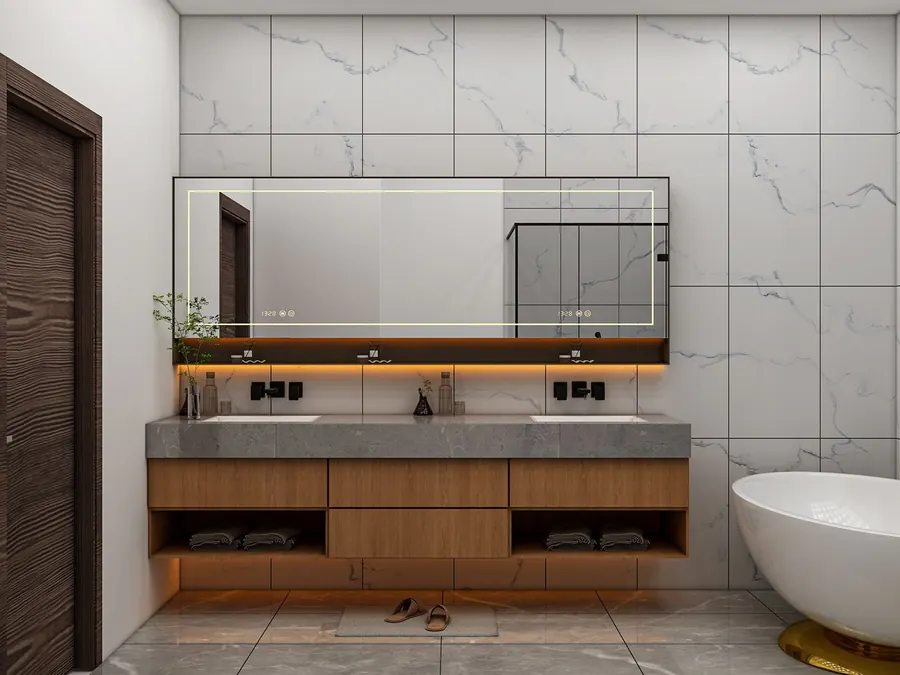
The rule we start from is that a mirror should never be wider than the vanity it sits over. When it is, the basin looks undersized and the glass looks as if it was bought for a different room. A mirror that stops a little short of each end of the worktop, somewhere around 50 to 100mm, reads as deliberate. Round mirrors break the rule in the other direction. They look right at roughly two thirds to three quarters of the unit’s width, because a circle as wide as the vanity overpowers it.
Double vanities give you a real choice. One long mirror across both basins makes a room feel wider and suits a contemporary scheme. Two separate mirrors, each centred on its own basin rather than on the cabinet doors beneath, feel more traditional and give each person a defined place to stand. If the basins aren’t symmetrical within the unit, centre the mirrors on the taps, since that is where you actually stand.
Height is governed from below as much as above. Wall-mounted spouts need clear space above them, and so does the splash they throw, so the bottom of the glass usually needs to sit 150 to 200mm above the spout rather than resting on the tap plate. At the top, lining the mirror up with the door head or with a tile course makes a small room look ordered rather than cluttered.
Light at the glass: colour temperature, CRI and the honest reflection
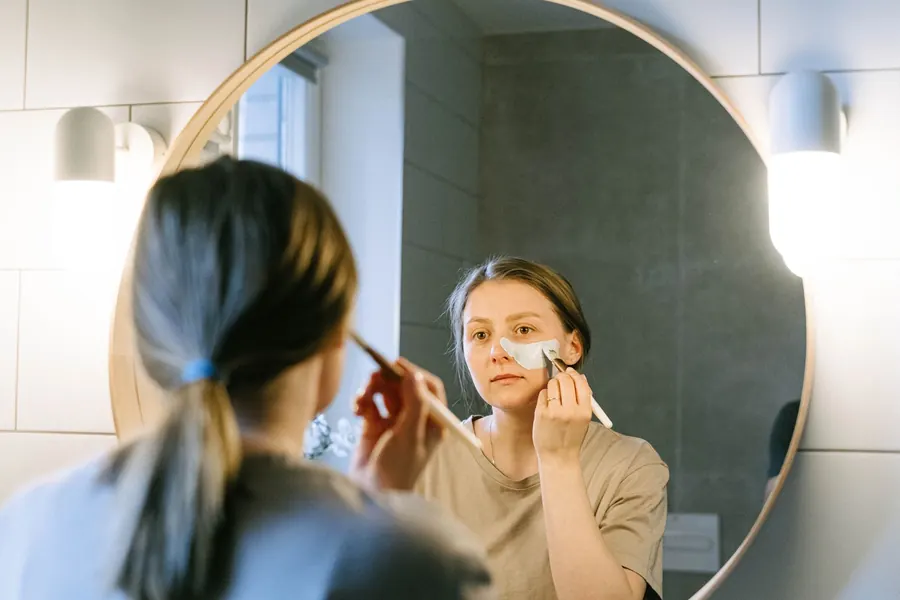
We went through the principles of lighting a face in our guide to getting bathroom lighting right, so here we’ll stick to what changes when the light is built into the mirror itself. Most illuminated mirrors now let you switch between warm, neutral and cool white, typically something like 3000K, 4000K and 6000K. That flexibility sounds generous, but the coolest setting is the one people rarely leave on for long. It renders skin slightly grey-blue, and makeup chosen under it can look heavy once you step into daylight. Neutral white is the setting most clients end up using every day.
Colour rendering matters more than colour temperature for shaving and makeup, and here the spec sheet needs reading closely. A CRI of 90 or more is the figure to look for, but the headline CRI is an average across eight pastel test colours and leaves out deep red. That red, called R9, is the one that governs how skin, lips and blood vessels look. Better mirror makers publish R9 alongside CRI. If a mirror lists CRI 80 with no R9 figure at all, assume the reds are weak and the reflection will look a little sallow.
Demister pads, steam and why the edges go black
A demister pad is a thin heating element bonded to the back of the glass. It warms a patch of the mirror a few degrees above the temperature at which steam condenses, so that patch stays clear while the rest of the glass fogs. It does not clear the whole mirror, and it takes a few minutes to get going, which is why we wire it to come on with the bathroom light or the extractor rather than giving it a switch nobody remembers. Pads can be retrofitted to a plain mirror, but they still need a fixed electrical supply, so it is far tidier to plan one in than add it later.
The more common long-term failure on bathroom mirrors is not fogging but black edges. The reflective layer is a thin coat of silver protected by paint on the back, and where the glass is cut that layer is exposed. Moisture, plus cleaning sprays that run down and sit along the bottom edge, slowly eats the silver from the edge inwards. Copper-free mirror glass resists this far better than older silvering, and it is what we specify. Behind it, a small air gap lets the back of the glass dry out, and the fixing should be a mirror-specific adhesive, since some general-purpose solvent adhesives attack the backing paint. After that it comes down to habit. Spraying the cleaner onto the cloth rather than the glass helps more than any product.
Bathroom zones, IP ratings and Part P for illuminated mirrors
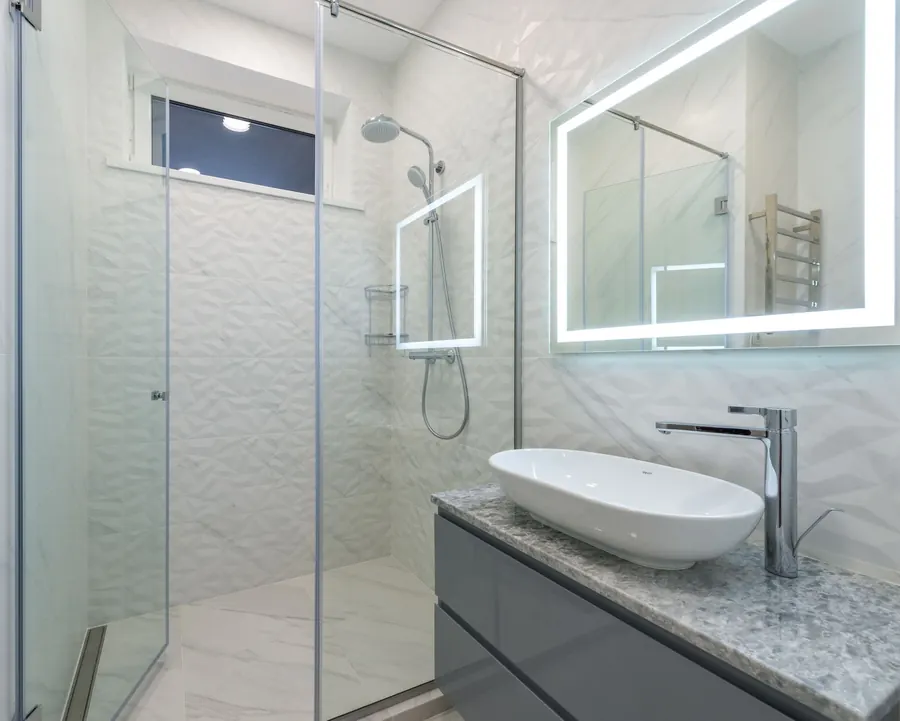
The wiring regulations, BS 7671, divide a bathroom into zones around the bath and shower. Zone 0 is inside the bath or tray, zone 1 is the space directly above it up to 2.25m from the floor, and zone 2 extends a further 0.6m out from the edge of zone 1. Anything electrical in zones 1 or 2 needs a rating of at least IPX4, meaning it can withstand splashing from any direction. Beyond zone 2 the regulations set no minimum, but we still choose IP44 mirrors throughout, because a basin throws water at a mirror more often than any shower does.
The same regulations explain why an illuminated mirror is hard-wired rather than plugged in. Ordinary socket outlets are not allowed within 2.5m horizontally of the edge of zone 1. The exceptions are SELV outlets and shaver supply units built to BS EN 61558-2-5, which contain an isolating transformer and are the only reason a mirror cabinet with a shaver socket can sit over a basin. Every circuit serving the room also needs 30mA RCD protection.
Whether the work has to be notified to building control is a separate question, and one we’re careful about. The government’s Approved Document P on electrical safety in dwellings makes three kinds of work notifiable: a new circuit, a replacement consumer unit, and an addition or alteration to a circuit within a special location. In a bathroom that special location is the space within 0.6m of the bath or shower and up to 2.25m high. A mirror over a basin on the far side of the room, fed from an existing lighting circuit, usually falls outside it. The mirror in the photograph above, a hand’s width from the shower glass, would not. Either way, the work still has to meet the regulations in full, and a registered electrician can self-certify the notifiable jobs without a separate building control visit.
Sinking a mirror cabinet into the wall
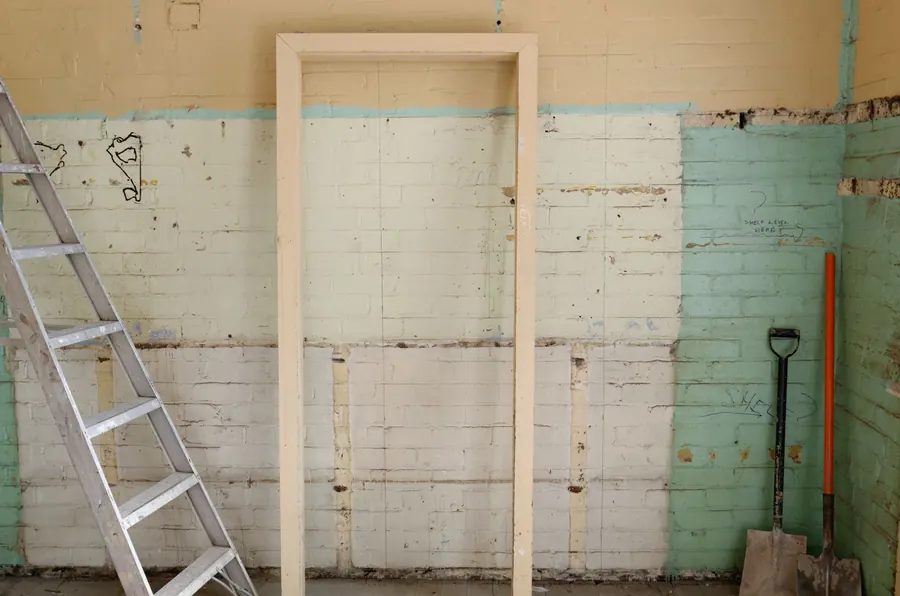
A recessed cabinet sits in the wall with only its door showing, so the basin keeps its headroom and the room loses nothing to projection. We covered the joinery of forming the opening in our piece on built-in storage and shower niches, so this section is about the checks before anyone picks up a saw.
Start with what is already in the wall. Bathroom partitions often carry the pipes and cables for whatever is on the other side, and a cabinet void is exactly where a radiator feed or a ring main likes to run. We scan and, where there’s doubt, open a small inspection hole first. Then think about the doors. A double-door cabinet between two wall lights needs enough clearance for the doors to open fully without striking the fittings, which is easily missed on a drawing and very obvious on the day. The other side of the wall matters too: a recessed box in a partition backing onto a bedroom will show as a bulge or a cold patch on that side unless the back of the void is boarded and insulated properly.
Semi-recessed cabinets, which sit half in and half out of the wall, are a sensible middle path. They need roughly half the depth, still look built in from the side, and suit walls that will only give up a little.
Where a recess won’t work in older Exeter houses
Some walls we meet regularly in Exeter and East Devon are ones where we would talk a client out of a full recess. The commonest is the party wall in a terrace. Across the Victorian streets of St Leonard’s, Mount Pleasant and Heavitree, the wall you share with next door is often a single brick thick, and it is doing two jobs at once: separating you from a fire next door and keeping their noise out of your bathroom. Cutting a cabinet-sized hole into it compromises both. It also carries a legal step many people don’t know about, because the government’s party wall guidance on work you must tell your neighbour about lists cutting into a party wall as notifiable, while drilling to put up cabinets is not. In practice a surface-mounted cabinet on a party wall is the cleaner choice.
Solid stone is the next. Older houses in the city sometimes have walls of red Heavitree stone or rubble masonry where the inner face is irregular and a neat rectangular opening means cutting through mixed stone, rubble fill and old lime mortar. It can be done, but the opening often needs a lintel, and the cost of doing it properly is rarely justified by a cabinet.
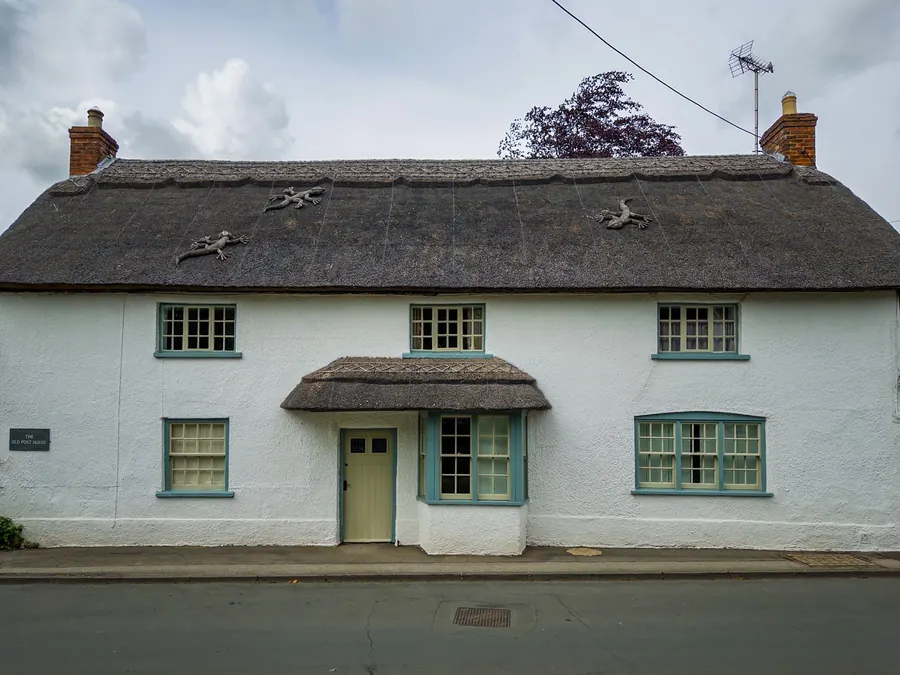
Cob is the one to take most seriously. The villages around Exeter have a large number of earth-walled cottages, and cob behaves nothing like brick. As the Society for the Protection of Ancient Buildings explains in its advice on unbaked earth walling, these walls have to breathe, and impervious materials trap moisture inside them with damaging results. A cabinet box sealed into cob with expanding foam and silicone, inches from a basin, is a fairly reliable way to do that. Many such cottages are also listed, which brings consent into it. In a cob house the mirror goes on the face of the wall, fixed into a timber ground or a built-out panel, and the storage goes somewhere else.
Common questions
Is an illuminated mirror better than a plain mirror with wall lights?
Not necessarily. Wall lights either side of a plain mirror give excellent light on the face and can be replaced individually, so the mirror outlives them. An illuminated mirror makes more sense in a narrow room with no space beside the basin for wall lights, or where the glow is part of the design.
Do I need an electrician to fit an illuminated mirror or mirror cabinet?
Yes. It needs a fixed connection rather than a plug, the circuit must have 30mA RCD protection, and the work becomes notifiable under Part P if it is a new circuit or falls within 0.6m of a bath or shower. A registered electrician can self-certify that work.
How wide should a bathroom mirror be?
Slightly narrower than the vanity below it, usually stopping 50 to 100mm short of each end. A round mirror generally looks best at around two thirds to three quarters of the vanity’s width.
Can a mirror cabinet be recessed into a party wall?
It is rarely a good idea. Cutting into a party wall weakens its fire and sound separation and needs formal notice to your neighbour under the Party Wall Act, whereas simply drilling to hang a cabinet does not. A surface-mounted or semi-recessed cabinet on another wall is usually the better solution.
Why are the edges of my bathroom mirror turning black?
Moisture and cleaning products are reaching the silver layer at the cut edges and corroding it. Copper-free mirror glass, a small air gap behind the mirror, the correct mirror adhesive and spraying cleaner onto a cloth rather than the glass all slow it down.