
Bathroom Lighting: How To Get It Right
Luxury Bathrooms Exeter
Lighting is the part of a bathroom that costs the least and changes the most. It is also almost always the afterthought. The suite gets months of thought, the tiles get a Pinterest board, and the lighting gets a single downlight in the middle of the ceiling because that is where the old one was. That one fitting is why so many otherwise lovely bathrooms feel flat and slightly grim.
There are really two halves to getting it right. One is safety, which is not optional and is governed by rules about where a fitting can physically go near water. The other is design, which is about layering light so the room works for shaving at seven in the morning and soaking at ten at night, two completely different jobs that one central light cannot do.
This covers both, including the one technical point that most published lighting advice gets wrong, and a local reason to think harder about brightness than you might expect.
The zones that decide where a light can go
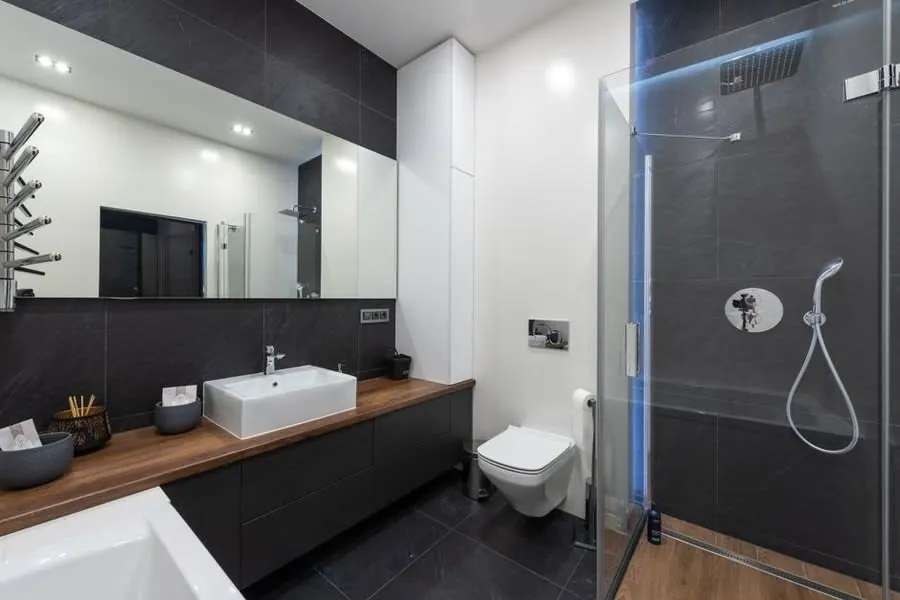
Water and electricity mean bathroom lighting is regulated in a way that lighting elsewhere in the house is not. The wiring standard, BS 7671, divides a bathroom into zones by how close they are to the water, and each zone sets a minimum protection rating for any fitting in it.
Zone 0 is inside the bath itself or the shower basin. A fitting here has to be rated IPX7, meaning it can survive being briefly submerged, and it can only run on 12 volts, not mains voltage. Zone 1 is the area directly above the bath or shower, up to 2.25 metres from the floor, and a fitting there needs a minimum of IPX4, protection against splashing from any direction. Zone 2 is the strip 0.6 metres beyond Zone 1, and it also needs IPX4 as a minimum. Beyond the zones there is no specific rating required, though the fitting still has to suit a humid room.
One rule sits over all of it: every circuit serving a bathroom must have 30 milliamp RCD protection, the fast-acting safety cut-out that disconnects the power in a fraction of a second if something goes wrong. That is not negotiable and it is one of the things a competent electrician certifies. Adding a new lighting circuit is notifiable work under Approved Document P, so it has to be signed off, whereas swapping a fitting on an existing circuit outside the zones is not.
The IP rating myth worth knowing
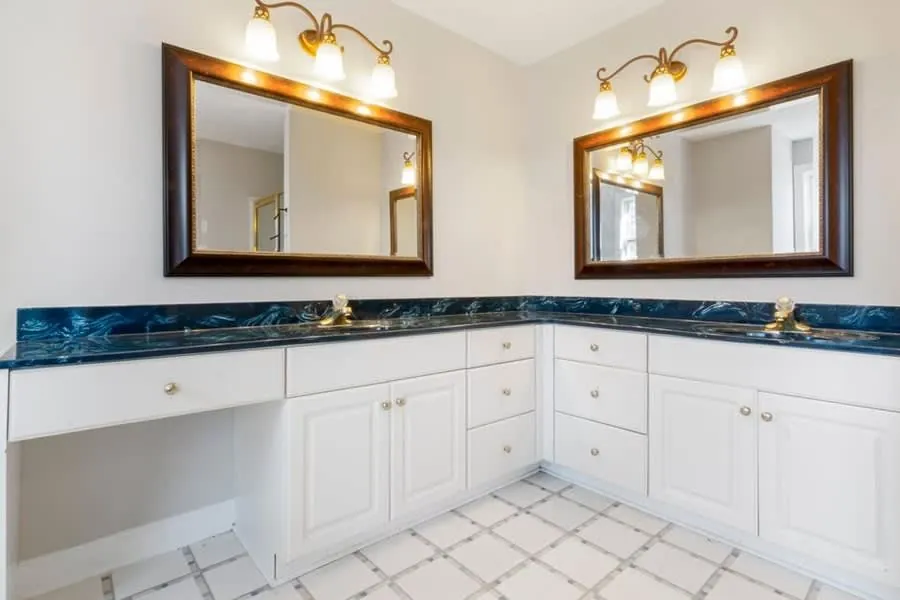
Here is a point where a great deal of published advice is simply wrong, and it is worth getting straight because it affects what you are told you must buy.
You will read, on plenty of retailer sites, that Zone 1 requires IP65 and Zone 2 requires IP44. Those are common product ratings and sensible upgrades, but they are not the actual requirement. The BS 7671 minimum for both Zone 1 and Zone 2 is IPX4. Many installers, ourselves included, will often specify a higher rating than the minimum for extra margin, particularly right over a shower, and that is a reasonable thing to do. But it is a choice for durability, not a rule you are compelled to follow, and it is worth knowing the difference so you are not sold a more expensive fitting on the basis of a regulation that does not say what you have been told it says.
The practical upshot is that you have more freedom than the scaremongering suggests. Outside the zones, in most of the room, you can use ordinary attractive fittings provided they are sensible for a humid space. The zones constrain the area right around the water, not the whole ceiling.
One light is the problem
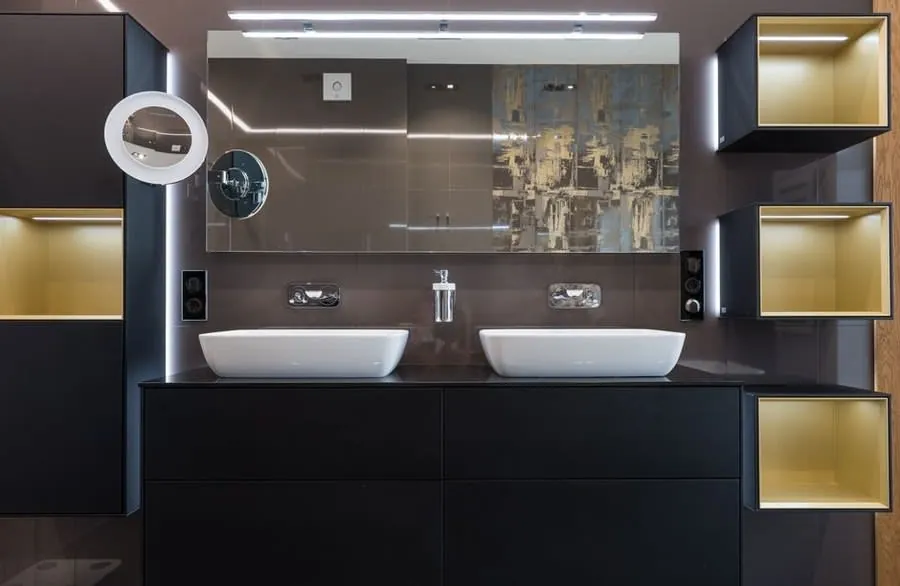
The single most common lighting mistake is relying on one central ceiling fitting, and it fails for a reason worth understanding rather than just asserting.
A light directly overhead puts your own head between the bulb and everything you are trying to see. At the mirror it casts your face into shadow. That is precisely backwards, because the mirror is the one place you genuinely need to see clearly. It flattens the room too, leaving the corners dark, and dark corners read as smaller and gloomier than they are.
The fix is layering, which means several light sources doing different jobs. Task lighting where you actually need to see, principally at the mirror. Ambient lighting to fill the room evenly, usually recessed downlights positioned over the functional areas rather than dead centre. And accent lighting, the concealed strip under a vanity or in a niche, that adds warmth and a sense of depth. You do not need all three in every bathroom, but you need more than one, and the difference between one light and three is the difference between a room that feels institutional and one that feels considered.
Light the mirror properly
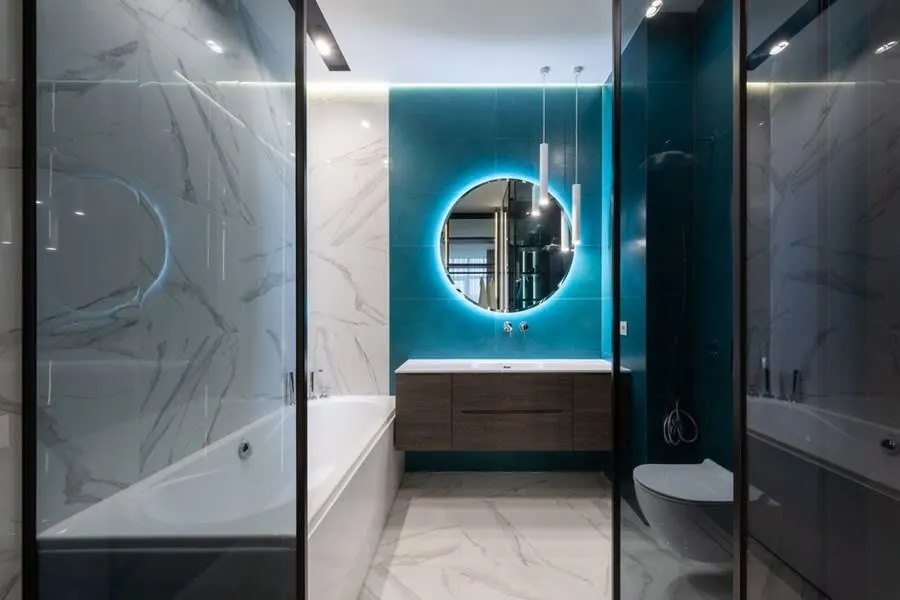
The mirror is where lighting earns its keep, because it is where you do the things that need accurate light: shaving, makeup, checking your face in general.
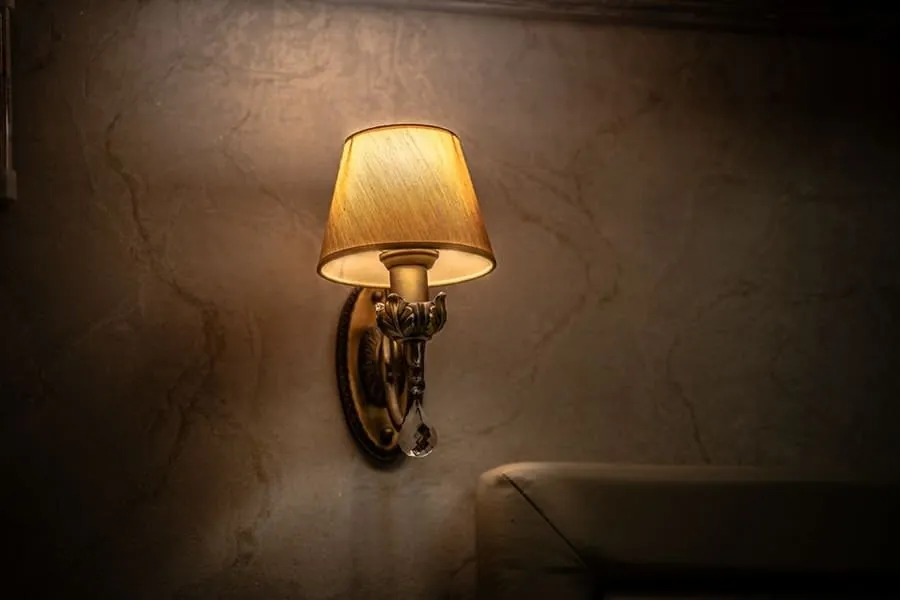
The principle is simple: light your face, not the top of your head. That means light from the sides of the mirror at roughly face height, or an evenly backlit mirror that surrounds your reflection with soft light, rather than a single downlight above throwing everything into shadow. Wall lights either side of the mirror are the traditional answer and still one of the best. A quality backlit LED mirror is the modern one, and it works beautifully.
Two qualities of the light matter here as well as its position. Colour temperature, measured in kelvin, sets how warm or cool the light looks: warm white around 2700 to 3000 kelvin is relaxing and suits ambient light over a bath, while a slightly cooler neutral white around 3500 to 4000 is better at the mirror because it renders detail more accurately. And the colour rendering index, or CRI, describes how truthfully a light shows colour. A high CRI, 90 or above, at the mirror means skin tones and makeup read as they actually are rather than shifted by the light. These are design recommendations rather than regulations, but they are the difference between a mirror that flatters and one that misleads.
Layers and controls
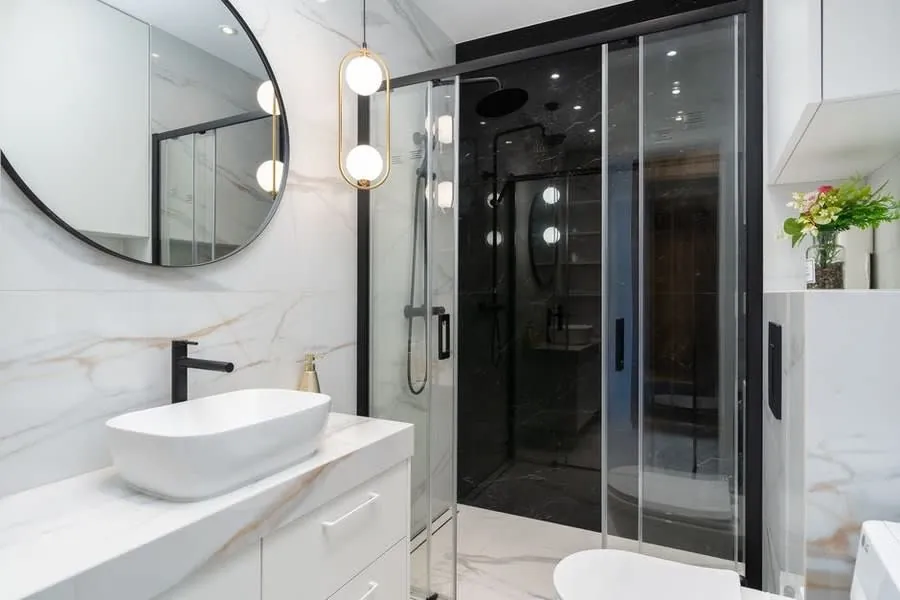
The thing that ties layered lighting together is being able to control the layers separately, and it costs very little to build in if it is planned before the walls are closed.
At its simplest that means two switches rather than one, so the bright task lighting and the soft ambient lighting are not forced on together. A dimmer on the ambient circuit is the single best-value upgrade in a bathroom, because it lets the same room be a bright practical space in the morning and a calm dim one in the evening. More elaborate schemes put the whole thing on scenes controlled from a switch or an app, which is genuinely pleasant but not necessary.
The point is that the wiring for all of this has to be run at first fix, before the plastering. Deciding you want a separate dimmed accent circuit after the room is tiled means chasing out finished walls, so it is one of those decisions that costs almost nothing in advance and a lot in hindsight. It is the same logic that runs through our whole design process: the cheap moment to decide is on the drawing, not on site.
A local reason to add more light than you think
There is a genuinely local consideration here, and it comes back to who lives in this part of Devon.
Eyes need more light as they age. The RNIB’s guidance on lighting makes the point that older eyes need considerably more light to see as well as younger ones, a figure often put at around three times as much by the age of sixty. The physiology behind it is well established: the pupil shrinks, the lens thickens and yellows, and more light scatters on its way in.
East Devon has one of the oldest populations in the country, with a median age over 60 in a town like Budleigh Salterton, so this is not a fringe concern for a lot of the bathrooms we design. It does not mean flooding the room with harsh light. It means designing in generous, well-placed, layered lighting with good controls, so the room can be turned up bright when detail matters and down low when it does not. That flexibility is exactly what a future-proofed bathroom wants, a subject we covered in our piece on planning a bathroom for later life.
Common questions
How many downlights does a bathroom need?
There is no fixed number, because it depends on the size and layout, but the useful principle is to position them over the areas you use rather than spacing them evenly like a grid. A typical family bathroom might have three or four, plus separate light at the mirror. What matters more than the count is that they are not the only light source and that the mirror is lit separately.
Can I put a light directly over the shower?
Yes, but it has to meet the zone requirement for that position. Directly above the shower is Zone 1, which needs a minimum of IPX4 protection, and many installers fit a higher-rated sealed fitting there for longevity. It also has to be on an RCD-protected circuit, like everything else in the room. A competent electrician will specify and certify this.
What colour temperature is best for a bathroom?
Warm to neutral white, broadly 2700 to 4000 kelvin. Warmer light suits ambient and relaxation lighting, for example over a bath, while a slightly cooler neutral white at the mirror renders detail and skin tone more accurately. Avoid the very cool blue-white light that suits a garage, because it makes a bathroom feel clinical. This is design preference rather than a rule.
Is a backlit LED mirror worth it?
Usually yes, because it solves the mirror-lighting problem elegantly by surrounding your reflection with even, shadow-free light instead of casting your face into shadow from above. Look for a good colour rendering index so colours read truthfully, and make sure it is wired in properly at first fix rather than plugged in, which looks far better and is safer.
Do I need an electrician, or can I change a bathroom light myself?
Changing a like-for-like fitting outside the zones around the bath and shower is not, in itself, notifiable work. But bathrooms are the one room where the safety margins are tightest, everything must be on a 30 milliamp RCD, and any new circuit is notifiable and must be certified. Given the stakes with water and electricity, this is a room where we would always use a registered electrician.