
Showroom, Independent Fitter Or Design-And-Install: Who Should Do Your Exeter Bathroom?
Luxury Bathrooms Exeter
Most people buying a bathroom in Exeter choose a buying model before they choose a bathroom, and they rarely notice doing it. Some head for the showrooms out on Marsh Barton, because that is where bathrooms seem to live. Some ring the fitter who did a neighbour’s en-suite. Others find a firm that draws the room and then builds it. Any of the three can give you a beautiful room. Where they differ is in who designs it, who buys the products, who fits them, who carries the risk when a valve starts weeping behind finished tiles, and who takes a margin at each step. On the high-end renovations we see, products usually come to somewhere between a third and a half of the final bill, and that slice is where the three models really split. It is only fair to say which one we are: a design-and-install firm, run from a base on Topsham Road, with no showroom. We will try to be even-handed about the other two all the same, because for some jobs they are the better buy.
Three ways to buy the same bathroom
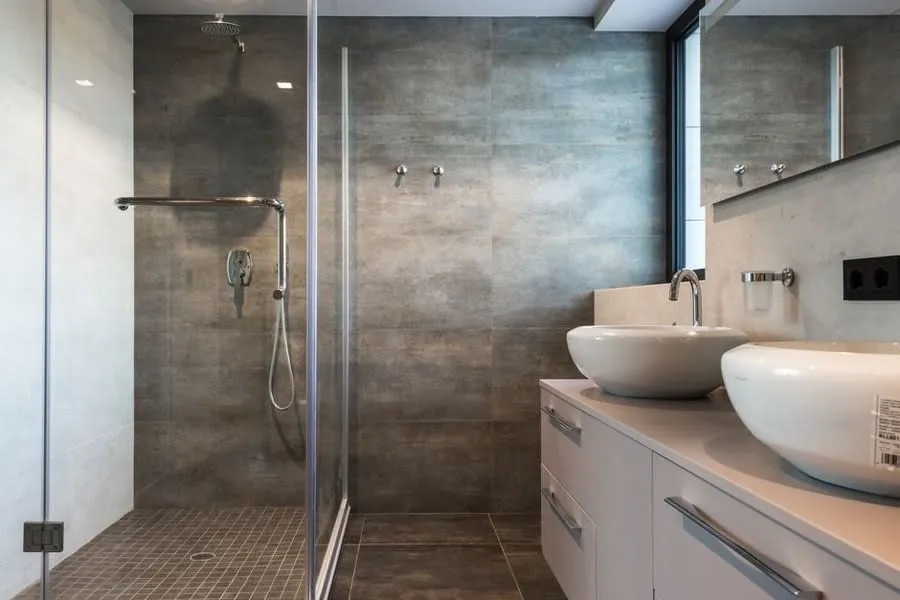
Strip each one down to who does what and it gets simpler.
In the showroom model, a retailer sells you the products and usually a design to go with them, often drawn up free or against a deposit. Fitting is then handled one of two ways. Either the showroom passes you to installers it recommends, who contract with you directly, or it sells installation as part of the package and sends its own team or subcontractors.
With an independent fitter, you hire a tradesperson, or a small team, to install the bathroom. The design is mostly yours. Sometimes the fitter supplies products at trade price; sometimes you buy them and the fitter fits what turns up.
In design-and-install, a single firm surveys the room, designs it, specifies and buys every product, manages the trades and hands over the finished bathroom under one contract. That is how our bathroom design service works, and it is also the dearest way to buy on paper.
Three sets of questions sort out which is which in a few minutes: who drew it, who ordered it, who fitted it. And then the one that counts - whose name is on the contract for each of those?
The showroom: you are buying confidence about how it will look

Seeing a basin at full size, running a hand along a vanity front, standing inside a shower enclosure: none of it can be done properly from a brochure, and a good showroom earns its money there. If you are torn between two bath shapes or can’t picture a 1200mm tile on a short wall, an hour among the displays settles questions that a drawing never will.
The cost of that confidence is built into the product prices. Display stock, floor space, a design team, sales staff, lighting and heating on a large unit all have to be paid for, and they are paid for through what you spend on taps and tiles. In general, showroom list prices sit well above what the same product costs a trade account at a merchant. The gap narrows during sales and on the retailer’s own ranges.
The second thing to understand is where the design comes from. A showroom designer is usually skilled and helpful, and is still designing with whatever the showroom stocks. Ask whether they can specify outside their ranges. Ask, too, who will actually measure the room: a design drawn from your sketched measurements has not yet met your joists, your wall plumbness or your waste runs.
The independent fitter: lower price, but you run the job
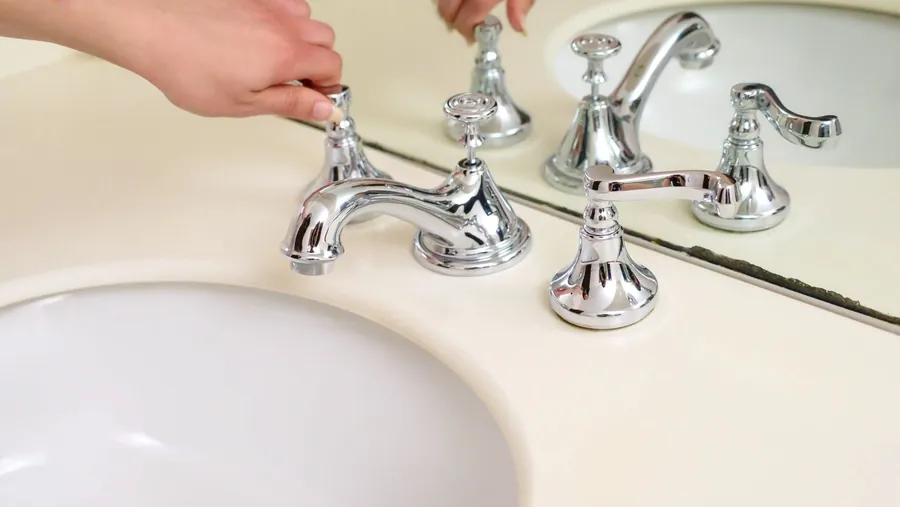
For plenty of jobs a good independent fitter is the sensible choice, and we would say so to a friend. You pay for the hands on the tools and very little else. No showroom, often no office, often no VAT if turnover is under the registration threshold.
What you take on in exchange is the project management. Someone has to decide the layout, choose and order every product, check deliveries arrive complete and undamaged, book the electrician and plasterer if the fitter does not cover those trades, and judge whether a problem halfway through is a product fault or a fitting fault. With an independent fitter, that someone is usually you.
It works well when the design is simple and the decisions are already made. Swapping a 1990s suite like-for-like in a semi in Alphington, keeping the same layout, with products picked from a merchant’s range, is exactly that kind of job. It works less well when the room is being reconfigured, when the wall has to hide a concealed cistern and a thermostatic valve, or when delivery dates for six products from four suppliers all need to line up with a two-week fitting slot.
Design-and-install: one contract and one point of contact

In this model the same firm measures the room, finds out what is under the floor and behind the walls, designs around what it finds, specifies every product by model number, buys them, sequences the trades and stands behind the finished job. The design is drawn by the people who will build it, which stops a drawing promising something the structure can’t deliver.
You pay for that coordination. Part of the price is design time, part is a margin on the products, and part is the project management that the independent route hands to you. On a straightforward bathroom that premium can be hard to justify. On a room that is changing shape, a wet room going in upstairs on timber joists, or a loft en-suite with its waste run going sideways through a 1930s house in Pennsylvania or Heavitree, it is usually money well spent, because those are the jobs where the gaps between designer, supplier and fitter cost the most.
The thing to check with any design-and-install firm is whether its design work is real. Ask to see a past specification sheet. If it names products, finishes and set-out dimensions, the design is doing its job. If it is a nicely rendered picture with “tiles TBC” underneath, you are buying the price tag of the model without the substance. Our design process sets out what we hand over and when.
Where the margins sit in each model
Nobody works for nothing, so the question is not whether a margin exists but where it sits and whether you can see it.
- A showroom takes most of its margin on products. Design is often free or refundable against an order, which is the giveaway. Where installation is sold too, there is usually a margin on top of the installer’s own rate.
- An independent fitter takes margin mainly on labour, a day rate or fixed price, and sometimes a small handling uplift on products bought through a trade account. Where you buy the products, the fitter’s margin sits almost entirely in labour.
- A design-and-install firm spreads its margin across design, products and management. Firms differ in how openly they show this. Ask whether products are priced at list, at a stated discount, or as a supply figure that bundles in ordering, storage and dealing with breakages.
There is no right answer here. A product margin is fair payment for the work of ordering, checking and replacing damaged goods, and nobody enjoys unpacking a cracked basin. The point is that a quote which looks cheap on labour may be making it back on products, and the reverse. Our post on comparing bathroom quotes in Exeter goes through lining up the documents themselves; here it is enough to know which part of the quote each model is likely to load.
When something goes wrong, who answers the phone?

This, more than price, is what separates the three models.
Suppose a concealed shower valve starts dripping inside the wall eight months after the room is finished. If one firm supplied and fitted it, one firm owns the problem. Under the Consumer Rights Act 2015, a trader supplying a service must perform it with reasonable care and skill, and goods supplied with that service have to be of satisfactory quality. Whether the cartridge was faulty or the joint was poorly made is that firm’s question to settle with its supplier, not yours.
Now split supply and fitting. You bought the valve from a retailer; an independent fitter installed it. The retailer can reasonably ask whether it was fitted correctly. The fitter can reasonably say the cartridge was faulty out of the box. Both may be right. You are left in the middle, with a wet wall and two businesses each pointing at the other. Most split jobs never get there. The ones that do are miserable, and the cost of opening tiled walls tends to be the biggest number in the argument.
Showrooms that sell installation sit in between. Read who you are actually contracting with for the fitting. If the installer invoices you directly, that installer is responsible for the fitting and the showroom for the goods, which is the split model again with a friendlier front desk.
Guarantees follow the same lines. Manufacturer warranties on valves, trays and brassware often depend on installation to the maker’s instructions, and some only run their full term if the product is registered within a set period after fitting. On a split job, agree who does that registration, because otherwise nobody does. A workmanship guarantee is only worth what the business behind it is worth. Paying the deposit by credit card adds a layer of protection: under section 75 of the Consumer Credit Act 1974, the card provider shares liability with the trader on purchases priced between £100 and £30,000.
Which model suits which kind of Exeter bathroom
Rather than one answer, here is how we would match them if it were our own house.
Like-for-like replacement, same layout
An independent fitter, with products from a merchant or a showroom sale. The design decisions are small and the coordination is light. Paying a design-and-install premium here buys you little.
You know the look but cannot picture the sizes
Spend an afternoon in a showroom, whichever route you then take. Ten minutes standing in a real walk-in shower answers more than an hour of looking at renders, and it makes any design meeting afterwards quicker.
A new layout, a wet room or a loft
Design-and-install, or a showroom design with a fitter you trust and a written agreement on who is responsible for what. Moving soil pipes, adding falls to a floor and building concealed frames are the jobs where a design drawn by someone who will not fit it most often fails on site.
Listed and conservation-area houses
In Topsham, central Exeter or the older parts of St Leonard’s, the designer needs to know what can and cannot be cut into, and the fitter needs to work to it. Keeping those in one firm cuts down the number of conversations that go wrong.
A tight budget and a fixed date
Whichever route gives you a fixed price against a full specification. The model matters less than whether the price is a real one.
Common questions
Is design-and-install always more expensive than using a showroom and a fitter?
On paper it often is, because you can see the design and management in the price. In practice the gap closes on complex rooms, because the split route tends to pick up extras: a second visit when a product arrives wrong, a delay while a missing part is reordered, or the cost of a disagreement over a fault. On a simple like-for-like swap, the split route is usually cheaper.
Can I buy my own products and still use a design-and-install firm?
Many firms will fit customer-supplied products, though most will exclude them from their own guarantee and charge for the time spent dealing with any that arrive damaged. Ask before you buy, and agree in writing who handles returns and replacements.
Who is responsible if a product I bought fails after it is fitted?
The retailer you bought it from is responsible for the goods being of satisfactory quality, and the fitter is responsible for fitting it with reasonable care and skill. In practice the hard part is proving which of the two caused the fault, which is why many people prefer one business to supply and fit.
Does a showroom design include a site survey?
Some do, many do not. A design drawn from your own measurements is a useful starting point, but someone still has to check floor levels, joist direction, waste routes and wall construction before anything is ordered. Ask who carries out that survey and whether the design will be redrawn after it.