
Bathrooms For Holiday Lets And Second Homes In East Devon
Luxury Bathrooms Exeter
A holiday let bathroom does something no family bathroom ever has to: it gets judged in writing, by a stranger, within a week of being used, and the verdict stays online for years. It is also worked harder than any domestic room in Devon - a coastal property let through the season might turn over forty-odd parties a year, which is closer to forty thousand litres of hot water through one shower than to the gentle routine of a household of three. Meanwhile the rules around letting have tightened: since April 2023 a property in England only qualifies for business rates if it was available to let for 140 nights and actually let for 70, and the furnished holiday lettings tax regime ended in April 2025. Owners are looking harder at what each room returns. The bathroom is where that question gets answered fastest.
A let bathroom is not a domestic bathroom with different towels

Most of the let bathrooms we are called to were designed as somebody’s own, then repurposed. That is where the trouble starts, because the two briefs pull in opposite directions.
A family bathroom is optimised for people who learn its quirks. The tap that needs a firm turn, the shower that runs cold if the dishwasher is on, the extractor with the pull cord behind the door - a household absorbs all of it within a fortnight and stops noticing. A guest has a week, arrives at nine at night after four hours on the A30, and interprets every quirk as a fault. Anything requiring instruction is a design failure.
The second difference is depreciation. A domestic bathroom sees a handful of showers a day from people who own it. A let sees the same volume of use from people who do not, plus wet swimwear, sand, sun cream, hair dye and a suitcase dragged across the floor every Friday. Specify for the use, not the room. That is not a case for making it cheap - it is the argument for spending differently, and it is why we scope a bathroom renovation for a let property from the housekeeping schedule backwards rather than from the mood board forwards.
What guests actually write about
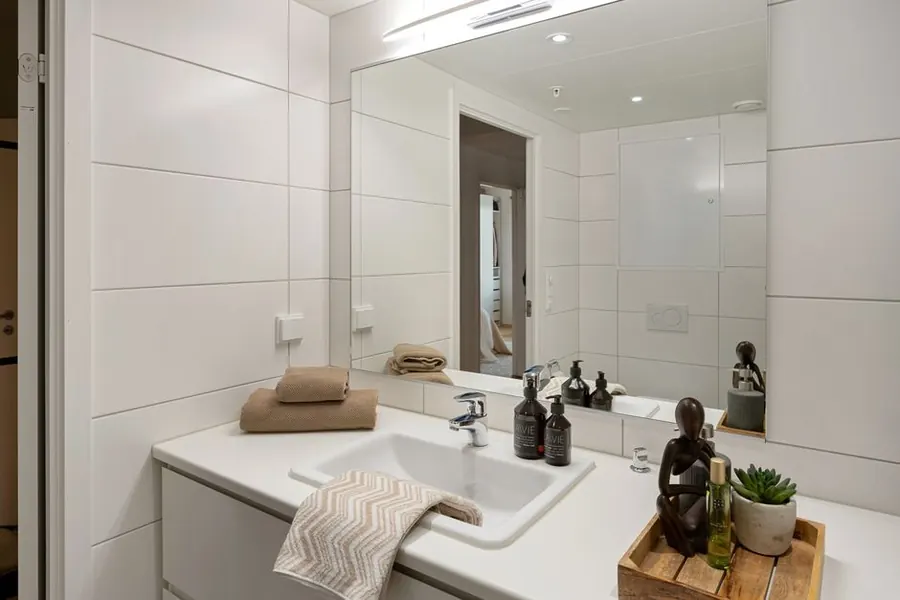
Read a few hundred reviews of Devon coastal properties and the bathroom complaints sort themselves into a very short list, and it is not the list owners expect.
Water pressure and hot water capacity come first, by a distance. A weak shower in a £1,400-a-week cottage is the single most reliable way to lose a star, and running out of hot water when four people shower after the beach is the second. Smell comes next - a bathroom that has been shut up between bookings and vents into a windowless hall gets described as damp whether or not it is. Then cleanliness, where the actual complaint is almost always grout, sealant and limescale rather than dirt: nobody can tell a stained silicone bead from a dirty one, and they will not give you the benefit of the doubt.
What barely registers is the thing owners most often spend on. Guests rarely mention brassware finish, tile format or the brand on the basin. They notice hot water, pressure, ventilation and whether the surfaces look clean. Get those four right in a plain bathroom and it will review better than a beautiful one that fails any of them.
East Devon water is harder than the rest of the South West

Owners who have moved down from the Midlands or the South East tend to assume Devon water is soft. Along this stretch of coast it is not, and the difference shows up in a let long before it shows up in a house.
Most of South West Water’s supply comes off Dartmoor and Exmoor - surface water from moorland rivers and reservoirs, soft to moderately soft, gentle on everything it touches. East Devon is the exception. As South West Water’s own water hardness factsheet sets out, supply here is drawn from boreholes deep underground and comes out slightly to moderately hard. Around Exeter the figure sits near 93 ppm, and it climbs as you move east and along the coast.
That is not hard by Home Counties standards, but it is hard enough to matter at let volumes. Limescale accumulates on the basis of litres passed, so a shower used forty times a week ages several years for every one of a domestic shower’s. The visible result is a furred head with dead jets, a screen that looks permanently dull, and a chrome finish gone patchy in eighteen months.
The fixes are unglamorous and effective. Specify a shower head with rub-clean silicone nozzles so a changeover clean actually removes scale rather than polishing round it. Choose brushed or PVD finishes over polished chrome, which shows every water mark. Avoid deeply textured tile and heavily patterned mosaic in the wet zone, since the grout lines are where scale settles and where nobody can clean between guests. And if the property runs on a combi with a fitted scale reducer, put its service on the same annual calendar as the boiler - they are routinely forgotten until the shower slows down.
Empty weeks, hot water and the legionella question

Every Devon let has a shoulder season, and a plumbing system that sits unused for six weeks in February behaves differently from one in a house somebody lives in.
Stagnant warm water is where legionella bacteria multiply, and holiday accommodation is explicitly within scope of the duty holder’s responsibilities. HSE guidance for landlords and property owners is clear that the requirement is a proportionate risk assessment and sensible control rather than routine laboratory testing or a purchased certificate. For a single let with its own supply, an owner competent to do so can carry out that assessment themselves.
The controls that follow are mostly about temperature and movement. Stored hot water wants to be at 60°C, cold below 20°C, and outlets should reach around 50°C within a minute of running. Outlets need using at least weekly, which in practice means the cleaner or caretaker flushing every tap and shower through during void periods rather than only before an arrival.
Design decisions make that easier or harder, which is why we raise it at specification stage rather than handover. Dead legs - a capped pipe left behind when a basin moved, a shower branch to a room nobody uses - are the classic risk, and they are almost free to design out while the floor is up and expensive to chase later. The same logic favours keeping the system simple: an unused second shower in a rarely booked en-suite is a maintenance liability, not an asset.
Built for a changeover, not for a family

Most Devon lets change over on a Friday or Saturday, and the housekeeping team has a few hours to reset the whole property. The bathroom is the room that decides whether that is comfortable or frantic, and almost nobody designs for it.
Watch a changeover clean and the pattern is obvious. Time goes on the shower screen, the floor-to-wall junction, around the WC pan, and anywhere a surface meets another surface at an awkward angle. So: a wall-hung WC and vanity clean out in a fraction of the time of pedestal units and take the floor cleaning with them. A single large-format tile with tight joints beats mosaic everywhere except where you need the grip. A walk-in screen with a single fixed panel has a quarter of the seals of a framed enclosure with a hinged door. A wall-mounted tap on a stone top removes the ring of scale that forms around every deck-mounted base.
Add somewhere for wet things to go. Coastal lets fill up with towels, swimwear and wetsuits, and a bathroom with a single hook behind the door ends up with everything draped over the bath, which then reads as untidy in the next guest’s photographs. A heated rail sized properly for the party the property sleeps - not the token 500mm one - solves a surprising number of complaints at once, including the smell.
Materials that survive a hundred strangers a year

A handful of choices differ from what we would put in an owner’s own house. They are worth being deliberate about, because each one is a decision you make once and live with for a decade.
Porcelain over natural stone on the floor, in nearly every case. Real stone in a coastal let takes sun cream, wine and salt from a dozen households a year and needs sealing on a schedule nobody keeps. A good porcelain that reads as stone gives you the appearance and none of the maintenance. Where the brief genuinely wants stone, keep it to a vanity top where it can be sealed in ten minutes.
Slip resistance is not optional. A wet floor, unfamiliar layout and guests of every age is exactly the combination that produces a claim, and a floor tile with a proper wet rating costs no more than one without.
Sealant is the item to over-specify, and it is the clearest example of the reordered priorities we described in our note on where to spend and where to save on a bathroom. Silicone is what guests see when they inspect a bathroom, and a cheap bead in a heavily used shower goes black within two seasons. Plan to renew it every couple of years as a maintenance item rather than treating it as permanent, and ask your fitter to leave a note of the exact product used so it can be matched.
Finally, buy sanitaryware whose spares still exist. A discontinued flush plate or an obsolete shower cartridge in the middle of August, with a booking arriving Saturday, is a genuinely bad afternoon. We specify mainstream ranges in let properties for exactly this reason, and keep a spare cartridge and seal kit in the property.
Timing the work, and what the numbers look like

Refitting a bathroom in a let is a scheduling problem as much as a building one, because every week the property is closed is a week of lost income - and, if you are near the threshold, a week that cannot count towards the 70 nights the property must actually be let. The government’s guidance on business rates for self-catering properties in England is explicit that nights lost to repair or refurbishment do not count toward the letting thresholds.
The practical window in East Devon is November to early March, and the best-run projects we do here are booked in the previous summer for a January start. Leave it until the New Year to enquire and the good fitters are already committed, because every other owner along this coast has reached the same conclusion at the same time.
As for cost, a straightforward single let bathroom to a genuinely durable standard is not a cheap-and-cheerful exercise, but it is usually less than the same room in the owner’s own house, because the brief is tighter and there is less bespoke. The number worth calculating is not the cost but the payback - what the property currently achieves per week, what comparable properties with a better bathroom achieve, and how many weeks of that difference the work represents. On the coastal properties we survey, a bathroom that lifts a listing from adequate to a reason to book generally pays for itself over two or three seasons, and it does it while removing the maintenance calls that eat a managing agent’s margin.
Common questions
Do holiday let bathrooms need to meet different regulations from a home bathroom?
The building regulations are the same, but additional duties apply because you are operating a business. The main one is legionella: as the person in control of the premises you are expected to assess and manage the risk in the hot and cold water system. Fire safety and electrical safety obligations also bite differently on let property than on your own home, so it is worth reviewing all three together rather than treating the bathroom in isolation.
Is hard water really a problem in East Devon?
More than most people expect. Unlike the Dartmoor-fed supply across much of the region, East Devon draws on boreholes and the water comes out slightly to moderately hard, sitting around 93 ppm near Exeter. At domestic use that is manageable. At let volumes it means visible scale on shower heads, screens and taps within a season, which is why we specify rub-clean nozzles, brushed finishes and simple tiling in let properties.
What is the best shower for a holiday let?
Whatever gives reliable pressure and enough hot water for the number the property sleeps, which usually means checking the system before the shower. On a combi, a good thermostatic mixer sized to the flow rate the boiler can deliver. On a vented system, a pump correctly matched to the head. Avoid electric showers where you can - guests read them as low quality even when they work - and avoid digital showers with proprietary controls that guests have to learn.
When should I book a bathroom refit for a Devon holiday let?
Aim for the work to happen between November and early March, and enquire the summer before. Closed weeks cost income and do not count toward the 70 nights a property must be let to stay on business rates, so a tight, well-planned winter programme is worth more than a cheaper quote with a vague start date.
Should I fit a water softener in a holiday let?
Usually not worth it in East Devon on hardness alone. A softener adds a maintenance task somebody has to remember, and the water here is not hard enough to justify it in most properties. A scale reducer on the incoming main, serviced annually alongside the boiler, plus fittings chosen to be cleanable, deals with the practical problem at a fraction of the cost and attention.